
‘A Catwalk On All Fours’: Can Soho Make Shopping Sexy Again?
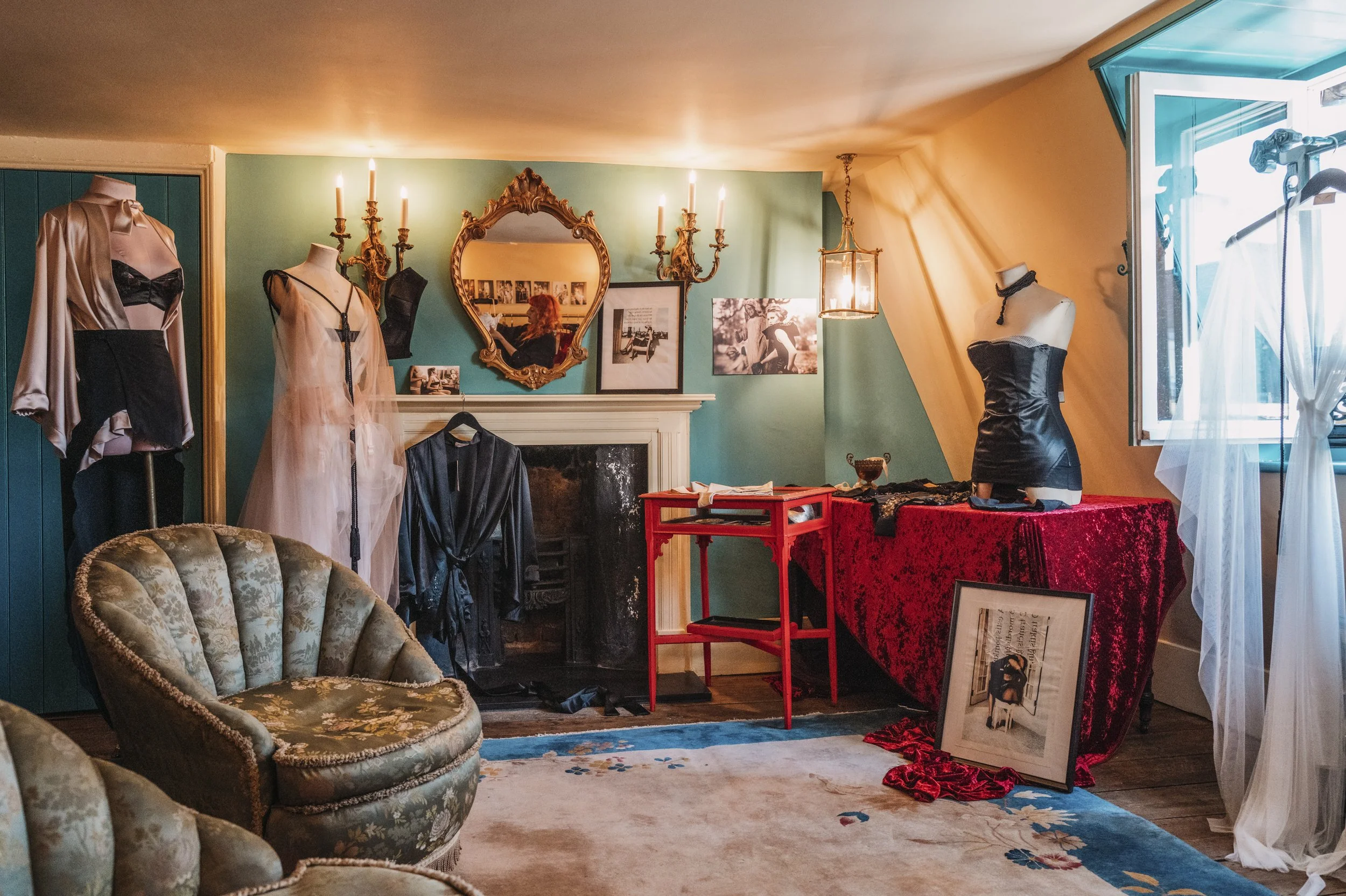
The Chinoiserie room at The Light House Soho
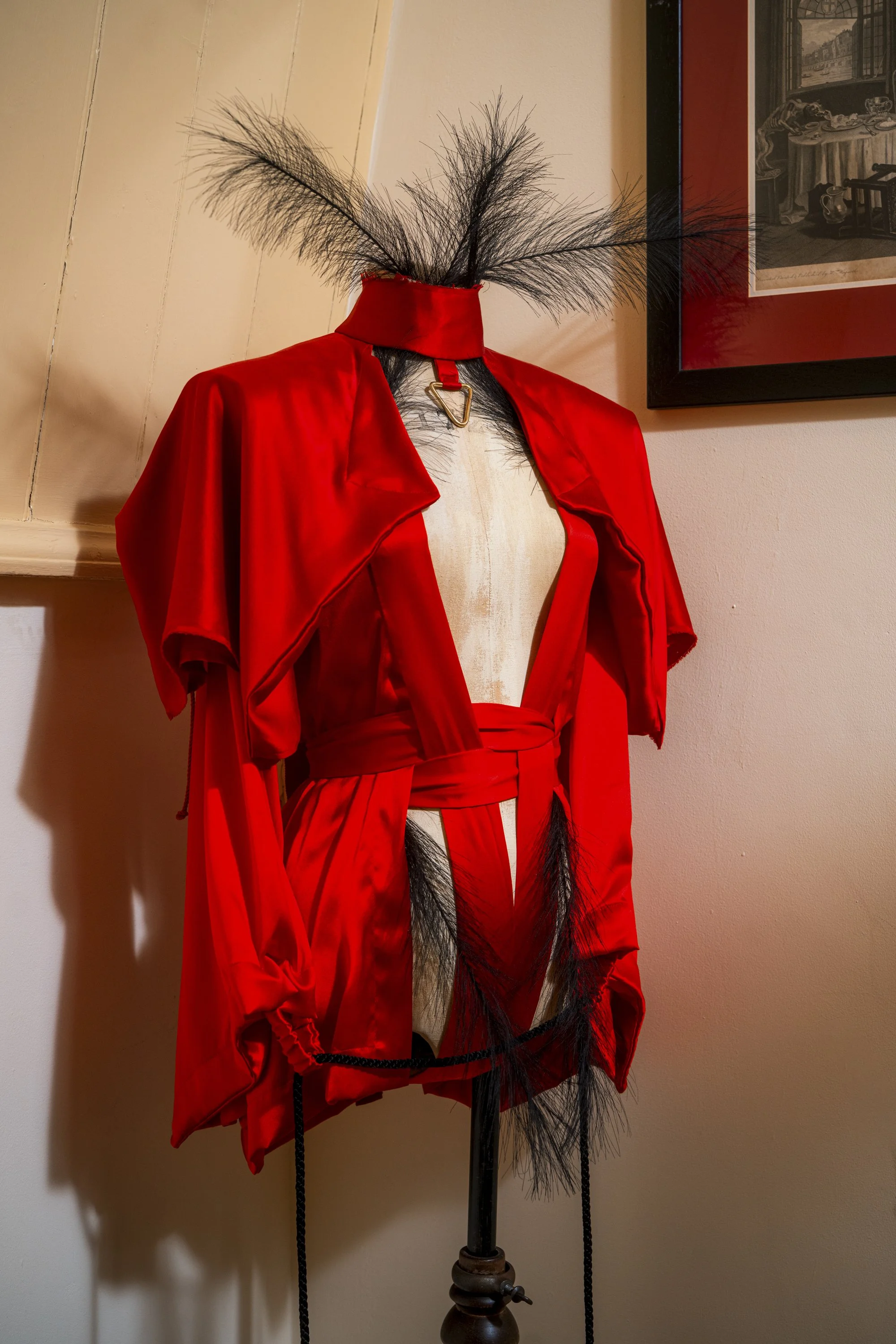
‘Have you ever seen a catwalk on all fours?’ asks Daniela Corcio, the flame-haired Italian founder of lingerie and boudoir-brand IKONOSTAS. She gets down on her knees and crawls the length of her pop-up in the seductively lit Chinoiserie room at the top of the Light House Soho. I can see what she means. The piece she’s demo-ing is a tight girdle-like skirt with a cut-out at the back that reveals a half-moon of posterior cleavage. Let’s put it this way: it’s not exactly office attire, though it looks great from above.
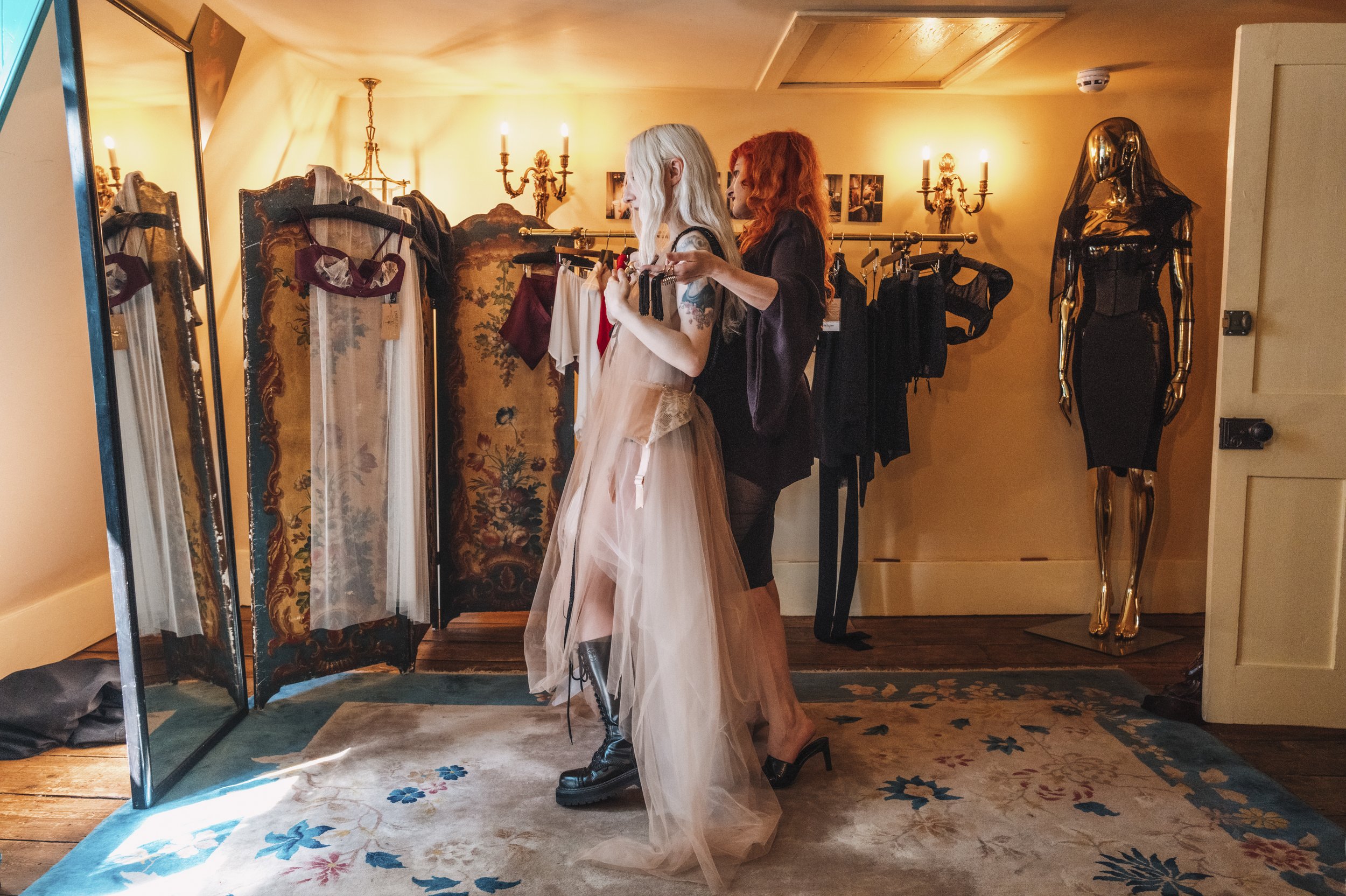
Pavel Anuska models (left) with Daniela Corcio (right)
‘It’s something you wear at home,’ Corcio explains, ‘but with heels.’ I don’t know anyone who wears heels at home except perhaps the late, greatest of greats, Dolly Parton. This is clearly a shortcoming of mine, because to be part of Corcio’s world is to be able to romp, to frolic, to have fun within your body. ‘Playfulness’ she notes, is a pillar of the brand.
‘All my designs come from the world I worked in most of my life, Prêt-à-Porter; and from theatre and performance, where I worked for eight years. I’m obsessed with the idea of transformation. On stage, what you wear can completely transform the character you become.’
The piece she’s demo-ing is a tight girdle-like skirt with a cut-out at the back that reveals a half-moon of posterior cleavage.
Corcio, who came of age in Florence, built a wide-ranging career in fashion. It included many years working for Vivienne Westwood before teaching at prestigious design school Polimoda, though her experiences creating for theatre are key to the Drama! of her current brand. ‘Once, the actors were shocked because I was still creating the costumes just before they went on stage,’ she reminisces, ‘I draped directly onto their bodies. They loved it, they found it so unique. It became a performance of its own.’
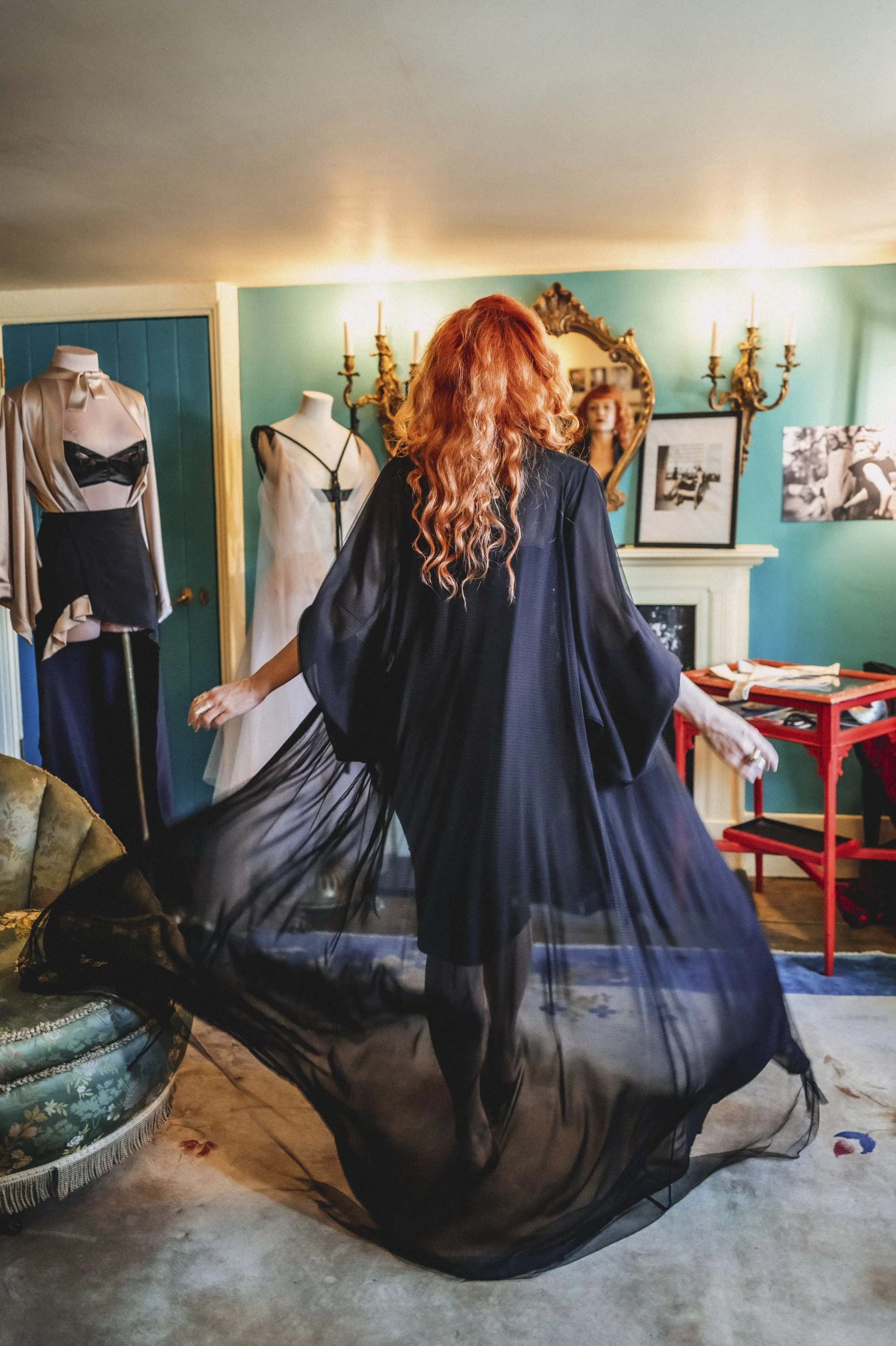
Corcio’s process always begins with the draping, rather than with pencil and paper – ‘I would have loved to be a sculptor!’ – and she describes herself as designing for moods rather than trends. ‘The wearer can be creative with the clothes, play with them and change their character.’ She’s also not shy about mixing fabrics or references.
‘I’m like a butterfly!’
Her journey into lingerie began when she was invited to take part in an international fashion show of designers in the field. ‘They saw my corsets and asked if I’d like to represent creativity for the city of Florence? I said “OK, let’s do it,’” and she paired recycled rubber with silk for the looks.
‘When I worked for other brands, I would build the structure of a collection around the brand identity, balancing the creative and commercial sides, bla bla bla… but when I create for IKONOSTAS, I want to be free’. She is animated again, and points at a silk kimono of gleaming white. ‘This one,’ she says, ‘is a night gown, but there’s the long straps that can be wrapped around your body to create a totally different mood.’ She pulls it on and moves the sleeves, ‘I’m like a butterfly!’
Meanwhile, the extended straps, redolent of Shibari ropes, can be flung around the neck to create a demure cowl or cinched around the waist or wrapped under the breast to accentuate the cleavage. ‘I’m always finding new ways to wear it,’ she muses, considering her reflection in the mirror. Then she comes alive: ‘When I was making it, I thought, underneath you’d have to wear knickers. I don’t like knickers! So! I made the straps even longer and I thought this has to be my knickers!’ She hoicks up her skirt and with a flourish of flying silks ties the straps of the kimono into a kind of banded, vintage-style crossover pantie. Absolute genius.
Pieces like this are her icons, linchpins in her collections, though in Corcio’s vernacular, ‘icon’ doesn’t mean the likes of Dolly Parton, but more ‘ikon’, the religious paintings of saints venerated in Eastern Orthodox churches. ‘I was in St Petersburg for an artist residency, she explains, ‘I observed during this and other travels, visiting Orthodox churches, people writing prayers and passing them to the priest, who took them behind the iconostas; the wall of icons separating the visible from the invisible. I became fascinated by this idea of a border between two worlds.’ Similarly, IKONOSTAS clothing is the physical manifestation of our invisible, but very real, secret desires.
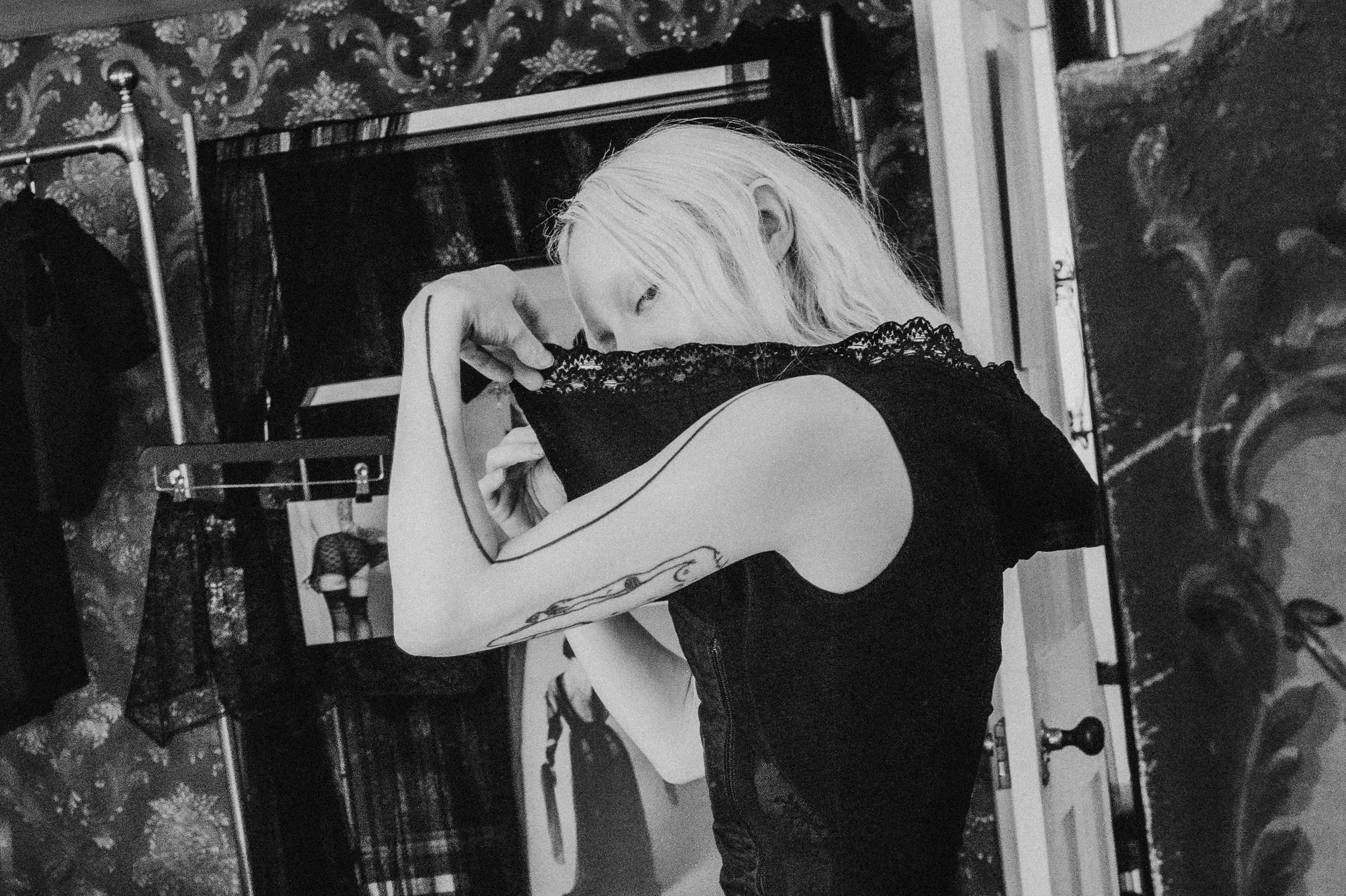
IKONOSTAS clothing is the physical manifestation of our invisible, but very real, secret desires.
Perhaps this metaphor can be extended to the Light House Soho, where Corcio sells her clothes. The brainchild of Joe Corré, co-founder of Agent Provocateur and son of Vivenne Westwood, Corré wanted to bring retail back into the real world. For the discerning shopper, bored to sobs by the impersonality of e-commerce, this is destined to become mecca.
It reminds me of old films and the Parisian couture houses of yore, but with far more accessible price tags. Customers can experience bespoke design, the anticipation of waiting for their item to be made, and direct access to designers who sometimes hand-craft their creations. Corré’s vision allows such one-of-a-kind makers to sell their clothes with no overheads, relieving small brands from relying on social media.
‘I chose to work in fashion because it is a powerful tool of communication,’ Corcio says, ‘But at the same time, I question this constant pressure to create something new, season after season, at any cost. You kill clothes this way’. After her debut in Florence, she realised lingerie delivered something different: clothes that are treasured, that can foster a connection between your mind and body, or yourself and a partner. ‘I said to myself, I like this world.’
Shopping has become sanitised and homogenous, but like Victorian repression, that’s inviting transgression. On the surface, we’ve historically presented as a buttoned-up culture… but there’s a flipside. We’re also peculiarly susceptible to subcultures, fetish, and other playful titillations. The Light House Soho speaks to this dormant need, to our glancing desire for the provocative and beautiful, like sensory caresses from butter-soft fabrics.
‘It’s lovely for women to come in and pick something up that makes them feel gorgeous’, says Alice Hartner, Managing Director of Light House.
The five-storey former Chandelier-factory is everything you’d want from a townhouse in Soho, from the art deco inspired façade to the front-of-house model-esque girl with a sleek 1920s black bob, to the suggestive Georgian prints hung along the narrow wooden stairs.
‘We’ve got to have a bit of Soho sleaze.’
The building – lovingly restored over seven years – reeks of anti-corporate spirit and lived-in sultriness. ‘Joe knows it’s important to be able to own something and not be dictated to by the various big Soho companies. He’s always championed the area,’ Hartner explains. When asked about the noticeable focus on lingerie and fetish, Hartner points out that Corré’s career was built on underwear. ‘He’s saved us from buying M&S knickers for the rest of our lives, hasn’t he?’ She laughs, ‘we’ve got to have a bit of Soho sleaze.’
For designers like Corcio, it’s a lifeline. ‘They give you the freedom to express yourself,’ Corcio says, ‘I’m so happy to be here, and I like that we [the designers] meet each other and exchange ideas’. She adds it’s great to be in Soho, given its colourful history, but ‘it’s also fun because you come from Oxford Circus, where everything is so commercial, and then you turn the corner… and there’s a whole different world behind this door.’
Photographs by Xavo Buendia