
‘We’ve Always Been the Silent Creators’: Reclaiming Heritage In A Global Fashion Economy
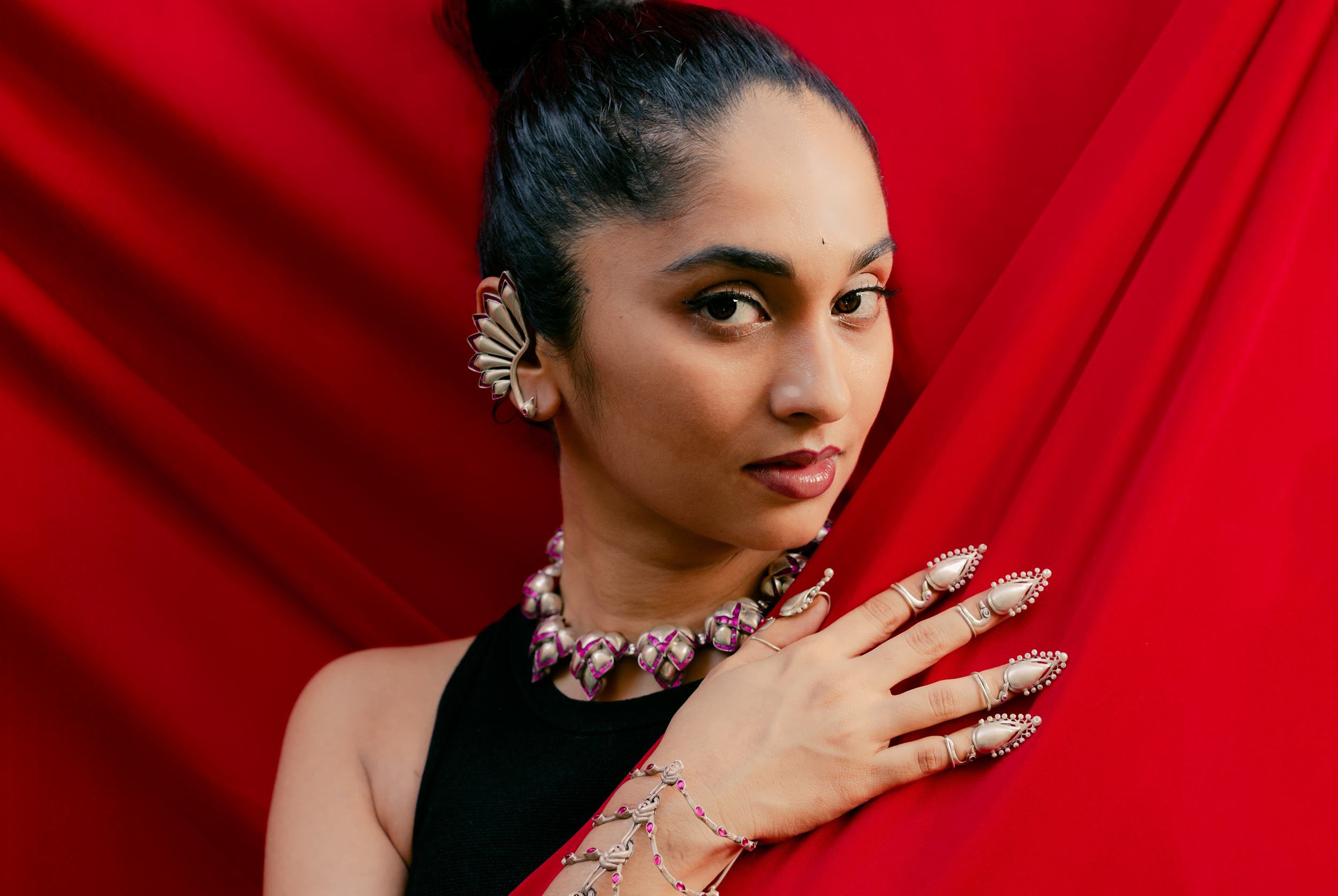
Bhavya Ramesh Jewelry
You’ve assembled the perfect outfit, now you automatically reach for a pair of jhumkas, your hottest accessory find of the year.
Half dome shaped, they are sparkle personified, with a jingle accompanying every movement. Sounds about right, considering they literally mean bell, derived from Jhumki, meaning ‘little bell’.

Model wearing Baby Jhumkas earrings. Photographer: Emily Farthing
But as the immortal Miranda Priestly of The Devil Wears Prada said, ‘You think that you’ve made a choice that exempts you from the fashion industry, when in fact, you’re wearing a sweater that was selected for you’. Indeed, centuries of artisanal work, passed through complicated trade and colonial routes, has culminated in the modern interpretation of jhumkas delivered to your algorithm. Not that you’d know it.
While most of us are just trying to keep up with trends, the ‘trend setters’ seldom bother providing us with context.
While most of us are just trying to keep up with trends, the ‘trend setters’ seldom bother providing us with context. Take the recent controversy around Margot Robbie, who wore the Taj Mahal necklace at the Wuthering Heights premiere. Inscribed ‘Love is Everlasting’ in Persian, this stone originally belonged to Nur Jahan Baygum-e Padshah, and later Mumtaz-I-Mahal (the empress buried in the Taj Mahal) before it mysteriously found itself in the West.
In 1972, it was gifted to Elizabeth Taylor by her husband, and its appearance on the red carpet referenced this Hollywood love story without ever acknowledging its roots. Igniting heated discussion online, this made viewers feel as though the South Asian origins had been erased, as though the only relevant romantic aspect concerned post-Indian ownership.
Culturally tone-deaf approaches to South Asian fashion are regrettably common. For another example just from this year, think of Ralph Lauren, who sent models out in jhumkas inaccurately labelled ‘authentic vintage accessory’. The word ‘authentic’ is a lazy catch-all, implying a possible cultural origin without bothering to credit it. ‘Accessory’ further obscures the heritage that the real name, jhumka, provides. Such buzzwords absorb the design into a homogenous global blob.
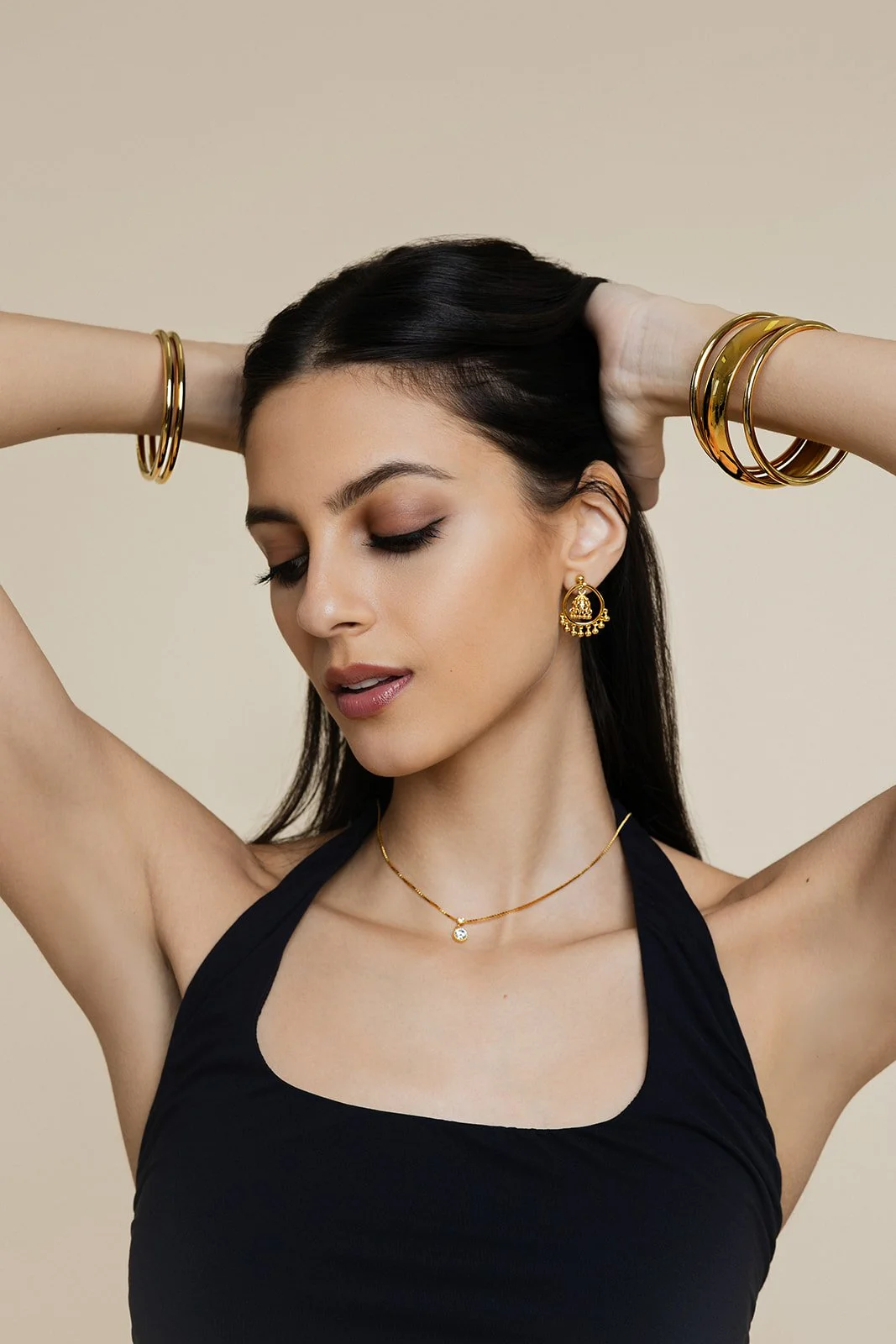
Model wearing Roshni Micro Jhumka earrings. Photographer: Emily Farthing
Amid the backlash, many voices emerged to remind the fashion community of the rightful name, among them the brand BySimran, founded by Simran Anand Pahwa.
‘I always say I want non-Indian people to wear my brand. I want them to respect Indian culture, Indian jewellery, Indian fashion, the same way people respect Italian textiles.’
Pahwa’s work has involved reimagining traditional silhouettes. But how does she decide what elements to retain and what to transform? ‘I’m scaling them down, but I still want to make sure they’re recognisable,’ she shares. After thorough research, the next step of her signature style was to make pieces more lightweight.
Having reintroduced the jhumka to a new generation by resizing them for daily wear, Pahwa feels a sense of duty as a first generation American to redefine how culture is embraced in the diaspora. For this reason, despite conversations around cultural appropriation, Pahwa is keen to keep the brand inclusive.
‘We can continue advocating for ourselves. I always say I want non-Indian people to wear my brand. I want them to respect Indian culture, Indian jewellery, Indian fashion, the same way people respect Italian textiles.’ Acknowledging Indian craftmanship only requires extending this practice a little further.
Anisha Parmar, a UK based artist and designer, feels that being raised in the diaspora offered her the magical experience of seeing tradition from a different angle. She describes heritage as ‘transient’, something you can respect while embracing the new. ‘The way in which I interpret my heritage has changed over time…I love that I can choose parts that define me at different stages of life.’
Her pieces provide a glimpse into the future of Indian jewellery; the acrylic, wood, layering and laser-cutting create statements in her Shakti collection, with inspiration drawn from Matkas (clay pots). ‘When we used to go on trips to India we saw these clay pots stacked up everywhere on roadsides,’ she says, explaining that the pots are integral to Navratri, a festival honouring the goddess, Durga. The sight of Matka or Garbho (Matka with holes and a candle placed in the centre so it emits light)symbolise a womb radiating light. ‘I thought it was such a powerful symbol of Shakti, the divine feminine power’.
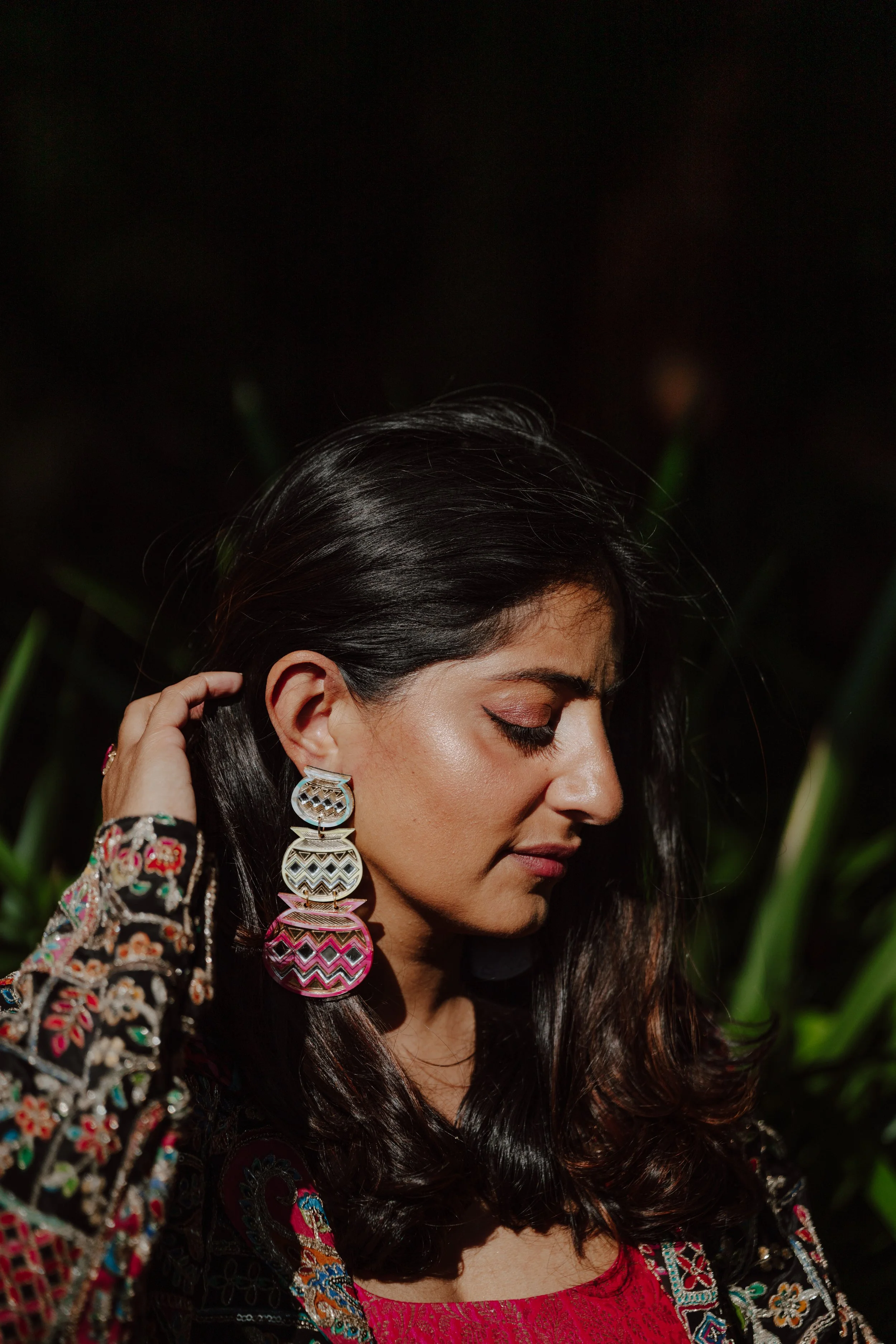
Anisha Parmar wearing Layered Matkas Multi Coloured. Image credit: Tess Viera Photography
‘The way in which I interpret my heritage has changed over time…I love that I can choose parts that define me at different stages of life.’
Alongside Parmar’s jewellery practice, she works as a curator and consultant. For a project with the National Trust titled, ‘My Adornment is my Power’she guest-curated a multimedia display of Indian artefacts acquired by George Curzon, Viceroy of India. ‘I remember seeing these objects in this dark case, poorly lit, almost trapped. I see these colonised pieces, specifically jewellery pieces in museums, that were “collected” or “amassed”, as forgotten objects. Just like us in diaspora, they’re uprooted from their root country, they’re placed flat and lifeless behind glass. They’re desperately longing for home and for people to see them, and to feel seen.’
Perhaps it’s this urge to enliven and celebrate beautiful things from a collective past that also animates Bhavya Ramesh. For her eponymous jewellery brand, she builds stores with display models that reference her Indian roots, such as extended hands in elegant mudras (ritual gestures).
When Ramesh first started out, she found that Indian jewellery was often restricted to traditional occasions, but she’s keen to create versatile pieces that can ‘hold a moment and have emotional value’.
On the topic of heirlooms, Ramesh is interested in recreating the feeling of legacy. ‘I wouldn’t say that something needs to be passed down, it can be valuable not only because of the metal that’s used, but also because that moment is irreplaceable’, she explains.
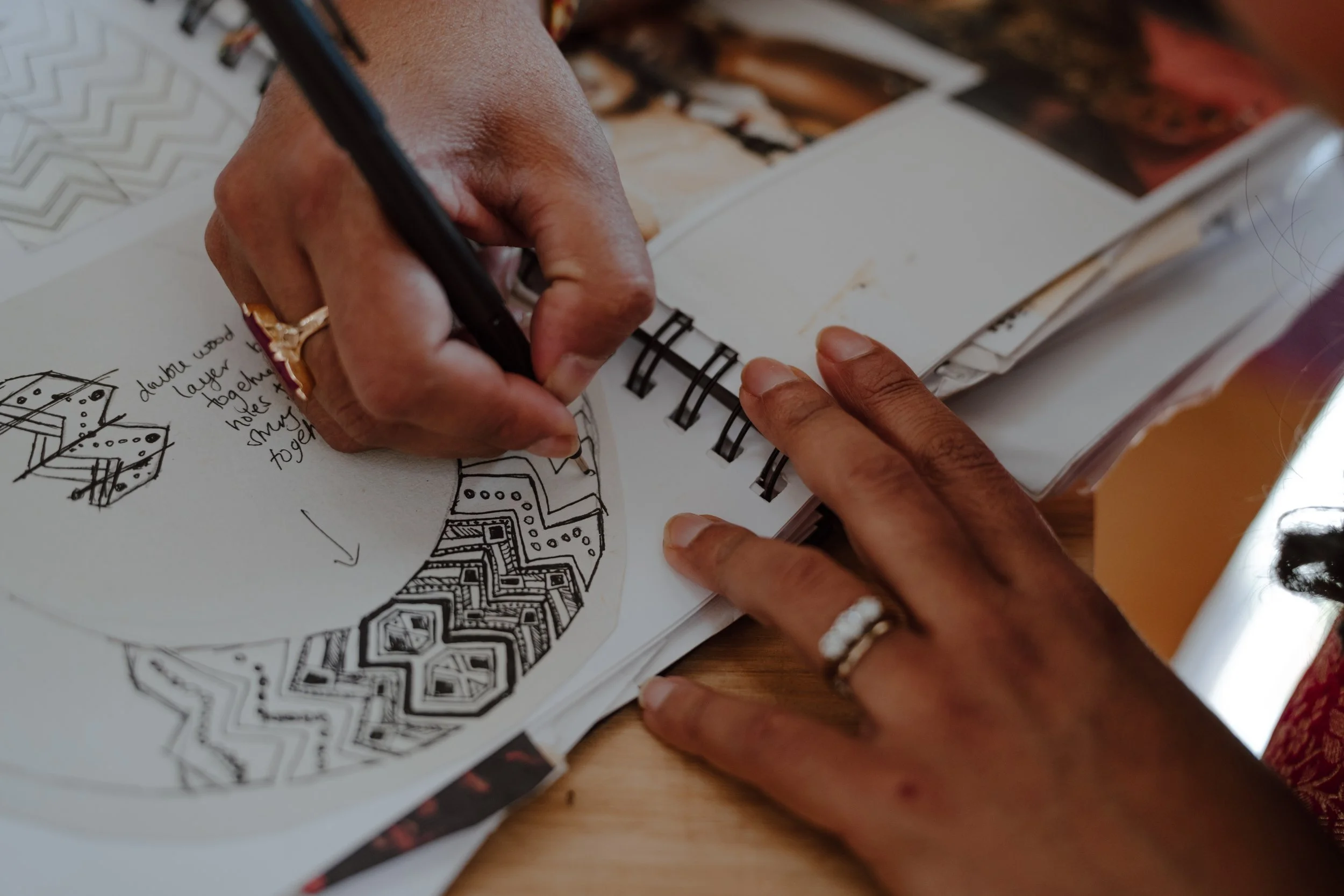
Anisha’s design process. Image credit: Tess Viera Photography
‘Sometimes something “new” comes up and it’s always been there, but it’s the way you come across it is very different’.
She also finds commonalities between past and present needs, pointing out that Mughal-era techniques like kundan, a method of setting gems in gold foil, can reuse waste gemstone fragments, something environmentally conscious buyers no doubt appreciate. ‘Sometimes something “new” comes up and it’s always been there, but it’s the way you come across it is very different’.
Ramesh has navigated questions of authorship and representation by being very upfront. Her collections are often named after their inspiration, such as Jalebi (a reference to the deliciously syrupy spiral sweet), which contains necklaces, earrings, bangles, and hair buns, all named after confectionaries.
Their designs mimic their sweet namesakes; the Boondi Bangle, for instance, is comprised of small spheres resembling real Boondi (fried chickpea droplets). The pieces are worn by a variety of models – her Jamoon Earclimbers are seen on older, turbaned models with magnificent moustaches. This diverse cast redistributes visibility and offers contemporary twists on historical design.
Whether they’re influenced by clay pots or candy, these creatives are intent on celebrating the Indian heritage that shapes their practice, bringing centuries of artistry to the forefront of fashion in a thoughtful way. As Ramesh puts it, ‘We’ve always been the silent creators and artists. Right now, we’re voicing it and people are able to see it.’