
Gerry’s Pompeii: A (Literal) Home for Outsider Art
Nearly two millennia ago, volcanic ash poured down from Mount Vesuvius and engulfed the city of Pompeii, leaving everything from mansions to graffiti perfectly preserved. Pompeii was constructed over generations by its inhabitants, but there’s a similarly remarkable location right in London that shares its name—this time built by one man, working in secret.
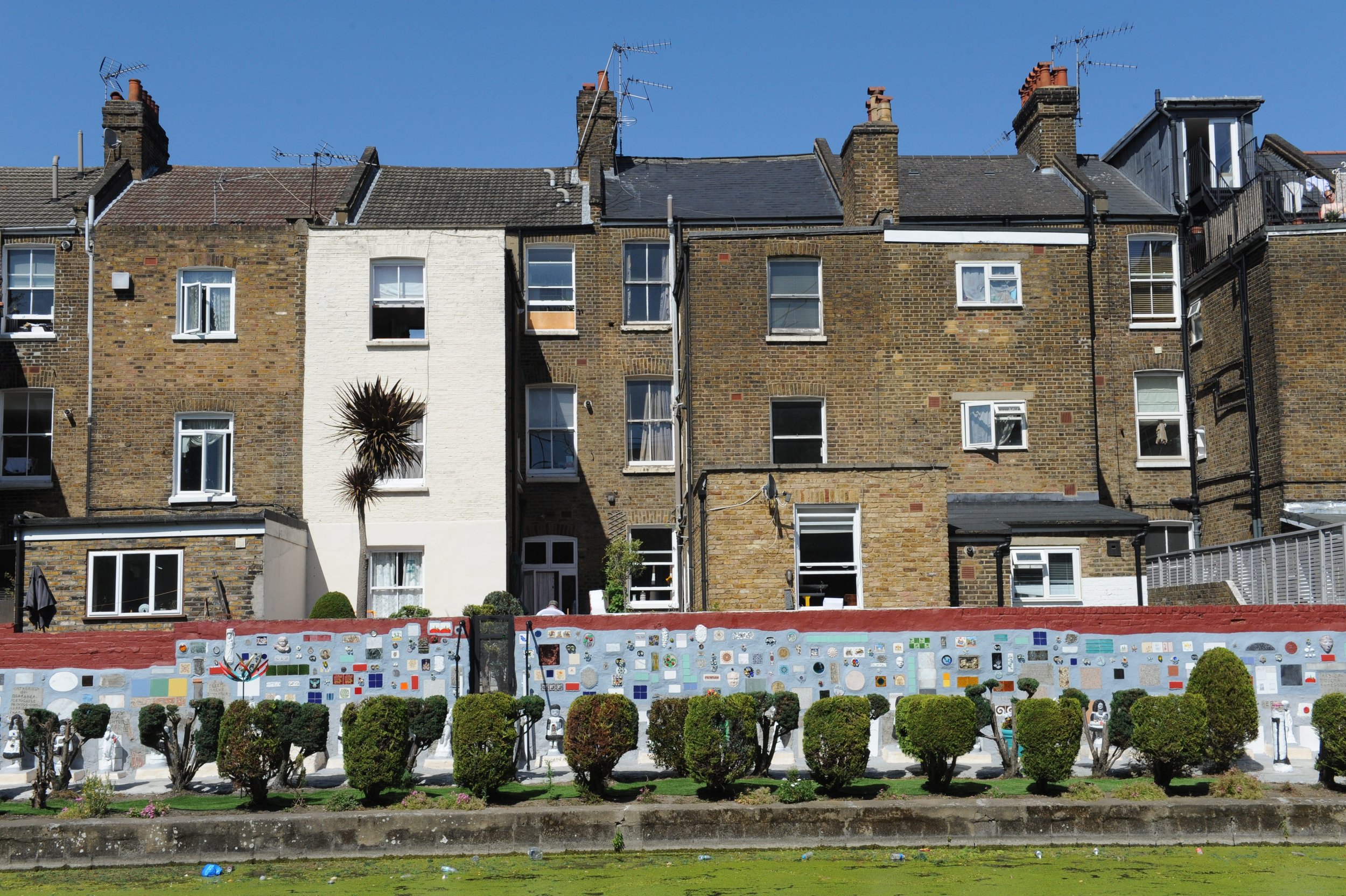
Grand Union Canal Towpath behind Gerry Dalton’s home
The statues have a distinct style: their skin is dove grey, they sport the bouffant hairdos of an 18th-century dandy...
Partially concealed by hedges, the casual passer-by on the Grand Union Canal Towpath in North Kensington might be startled to discover a row of squat figures that look like a cross between a voodoo doll and a Regency judge. This is the late Gerry Dalton’s sculpture garden, and while it’s smaller than its ancient namesake, that’s not to say it’s bereft of Roman influence: look closely, and you might spot the emperor Claudius (his imperial brethren Hadrian, Titus, and Marcus Aurelius have been moved elsewhere by Dalton’s family).
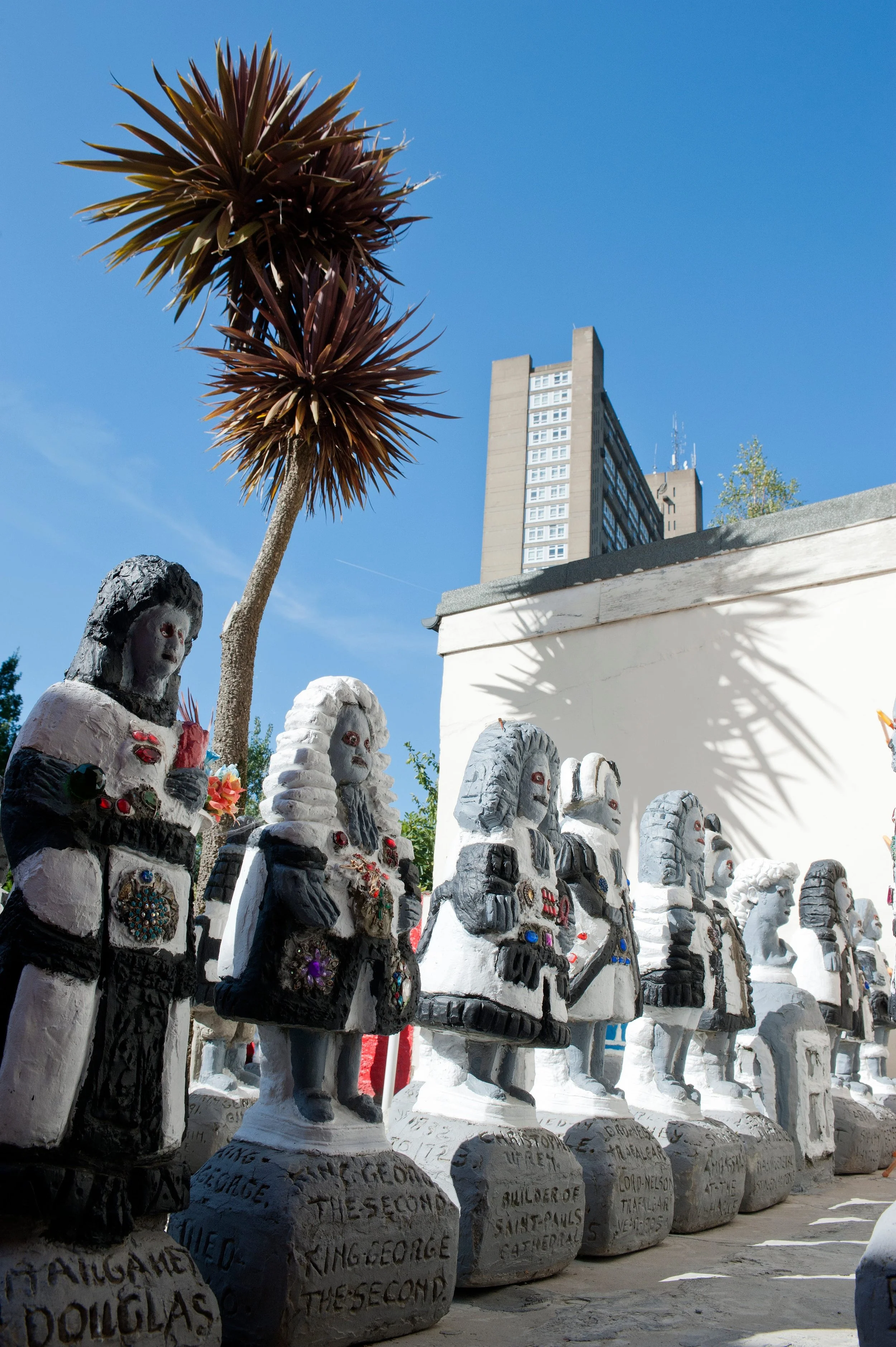
Dalton’s line-up of sculptures stands in the Brutalist shadow of Trellick Tower
Dalton’s line-up of over a hundred sculptures stands in the angular Brutalist shadow of Trellick Tower. Each figure’s name is inscribed on their pedestal, or on rough squares of unpainted concrete above them. The statues have a distinct style: their skin is dove grey, they sport the bouffant hairdos of an 18th-century dandy, and their eyes are raccoon-ringed in brick red.
The statuettes are both touchingly naïf and oddly dignified
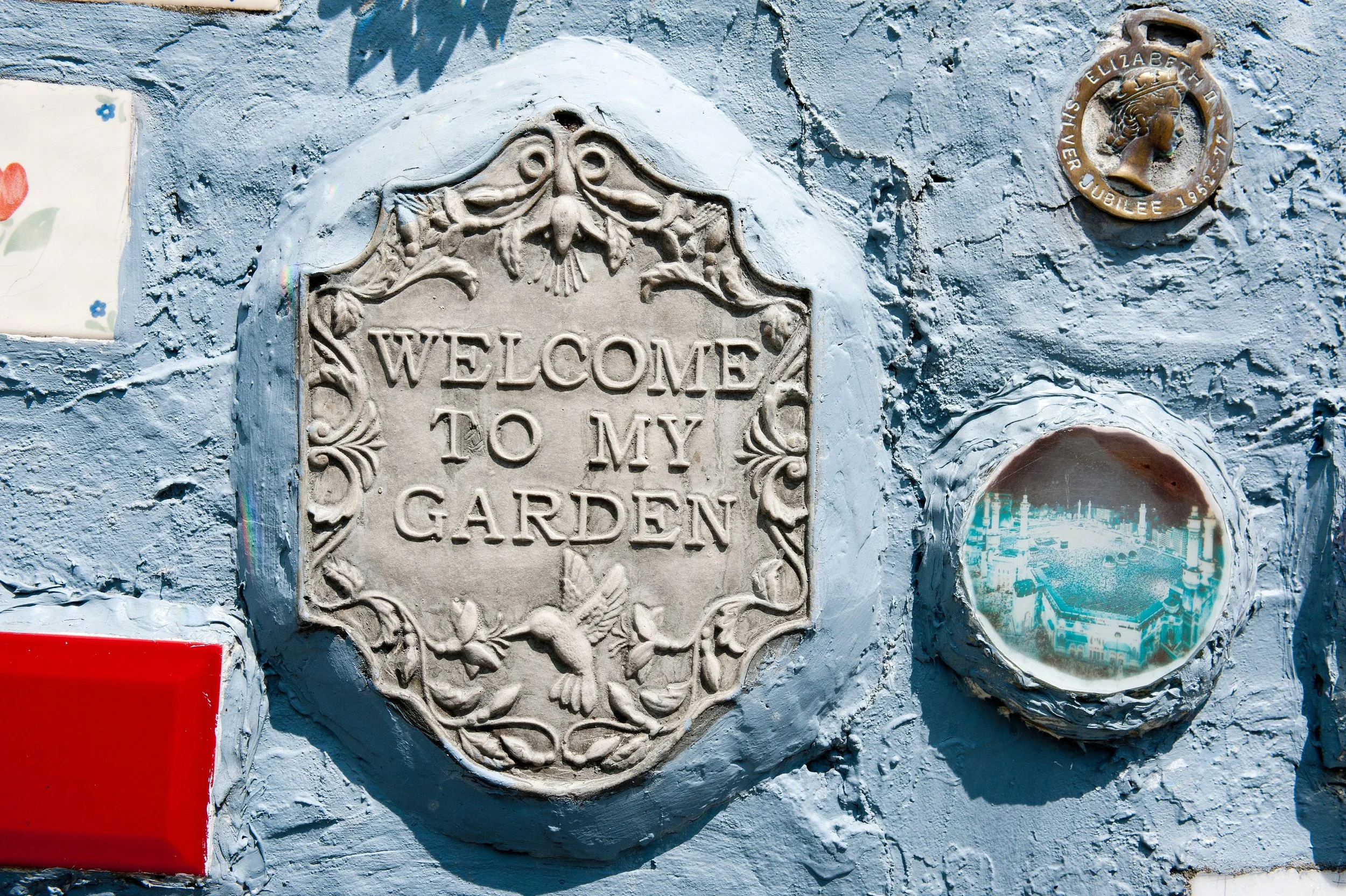
The statuettes are both touchingly naïf and oddly dignified; all the more so for the colourful mise-en-scene Dalton created for them. The wall behind the figures is painted pastel blue and warm cinnamon, and embedded with the same glittering assortment of bric-à-brac that pebbles their stout little bodies: glass beads, costume jewellery, rhinestones, mirror fragments and patterned garden tiles. The effect is carnivalesque, as though Dalton dressed up his creations for a parade.
An Irishman in London who worked blue-collar jobs all his life, Gerry Dalton lived in social housing on Hormead Road, with access to the towpath from his garden. He created his curious kingdom in retirement, working mainly at night and in secret. His low profile birthed the quote his project is named after: ‘They’ll be astonished by what they’ll find in my garden in years to come. It’ll be like Pompeii or something… Gerry’s Pompeii.’
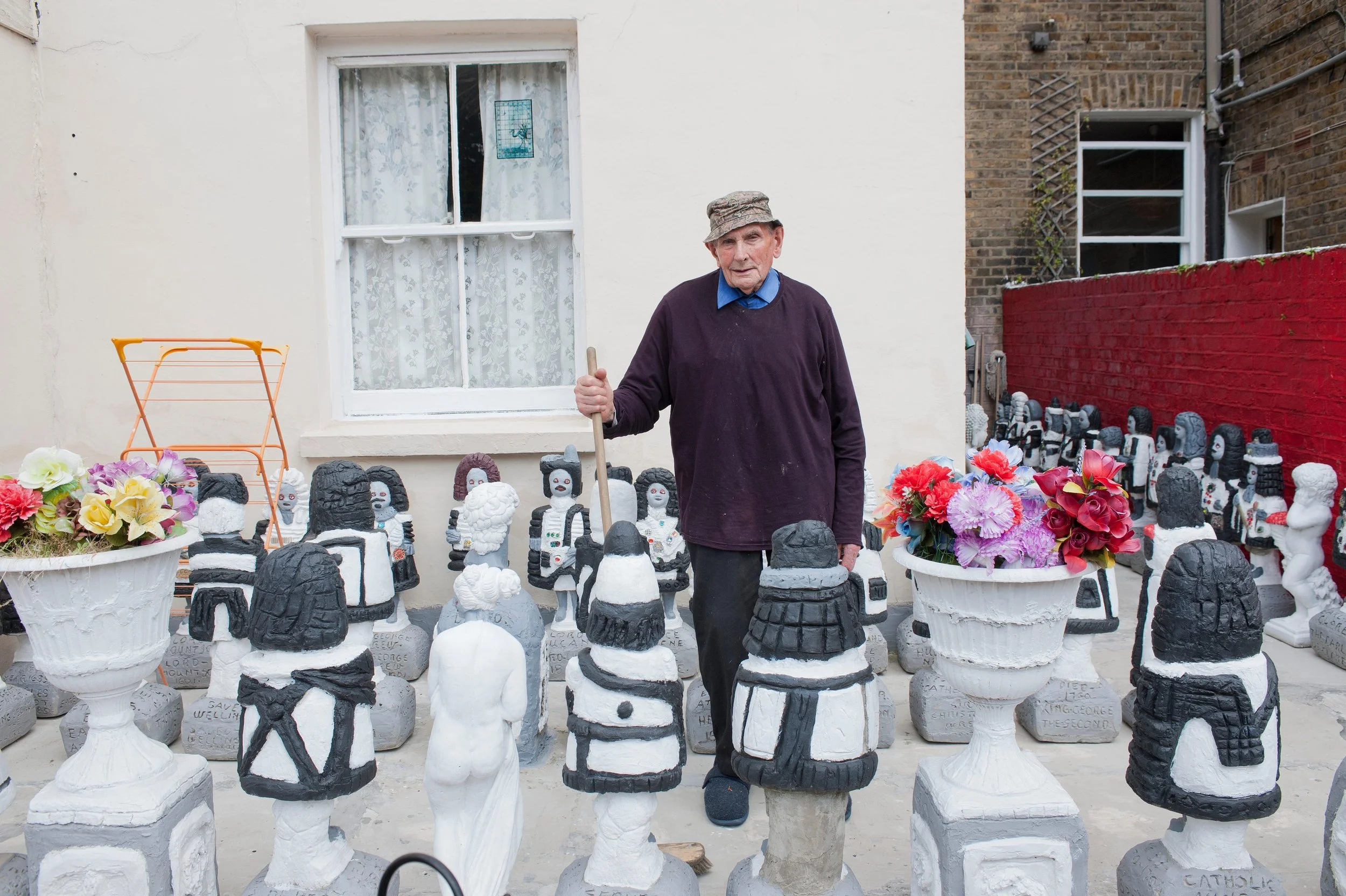
Gerry Dalton with his sculptures in his home on Hormead Road
‘They’ll be astonished by what they’ll find in my garden in years to come. It’ll be like Pompeii or something… Gerry’s Pompeii.’
Dalton sadly passed in 2019, but his world lives on in the hands of Sasha Galitzine, the irrepressible director of the charity she set up in his name. Before COVID, Galitzine raised 300k to preserve Dalton’s legacy, and his cause has attracted a coterie of high-profile names, from Stephen Fry to Jarvis Cocker to Sir Nicholas Serota, former director of Tate.
‘It’s just so pure. He had to make it,’ says Galitzine, ‘it was a compulsion.’ In galvanising locals and celebrities to protect Gerry’s Pompeii, Galitzine found a refreshing way to share art beyond the white cube. ‘Anyone that visits connects with it in an overwhelming way,’ she continues, ‘It has the power to move everyone; people from all backgrounds, ages, cultures.’
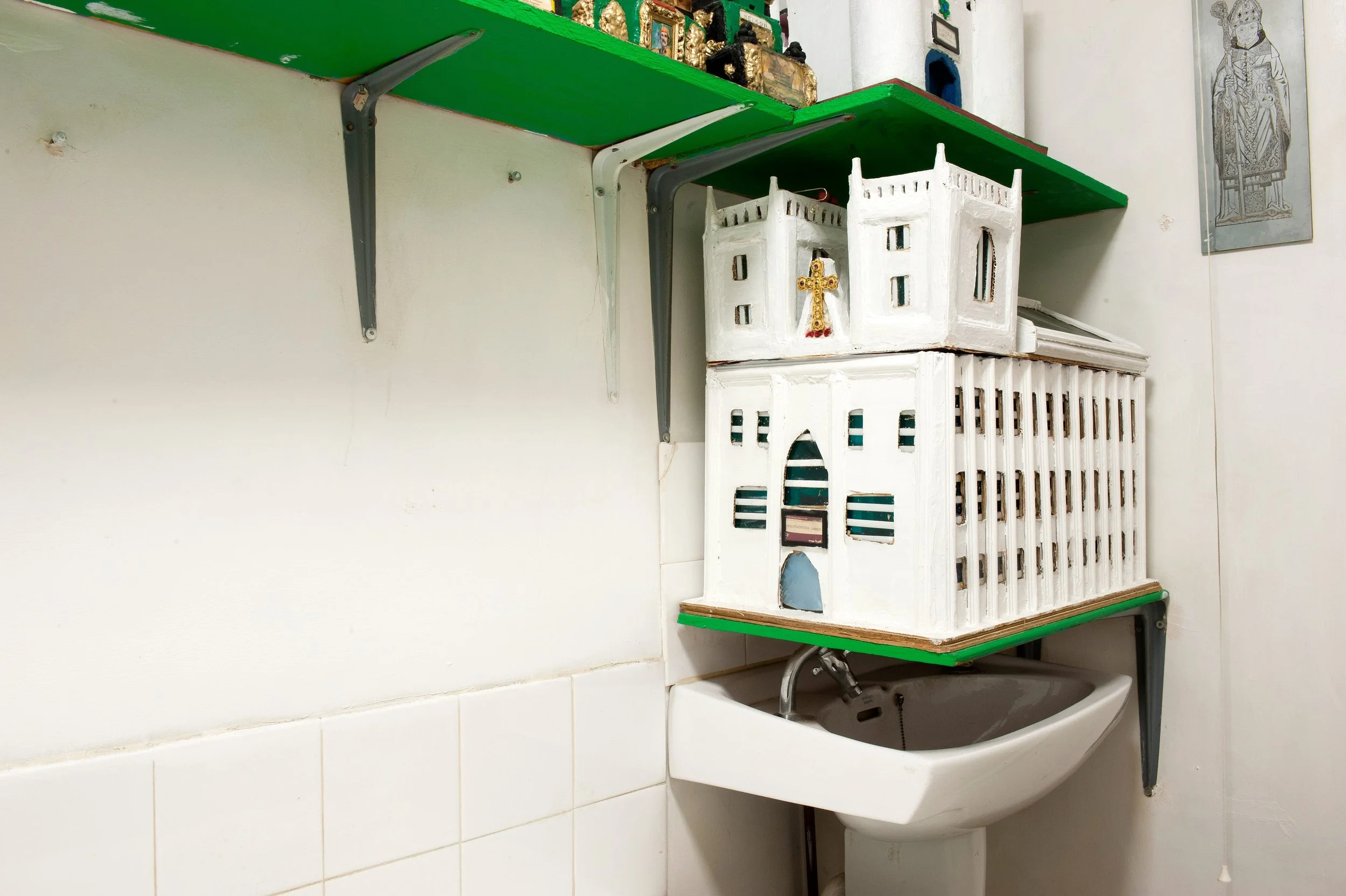
‘Anyone that visits connects with it in an overwhelming way’
Perhaps it’s the accessibility of Gerry’s Pompeii that unites people. It is mysterious and absorbing, but without pretensions to what lofty dealers tone ‘high art’. In fact, it’s a prime example of what’s called ‘outsider’ or ‘visionary’ art, a term for self-taught creatives with little or no contact with the art establishment, creating atypical works to satisfy what can be akin to a compulsion.
Gerry’s masterpiece, while uniquely recognisable, isn’t the only outsider artist’s home in the UK. There is Sue Kreitzman, who painstakingly decorated her Bromley-By-Bow ex-council flat with dumpster finds, or Stephen Wright’s House of Dreams Museum, opened in 1998 and now bequeathed to the National Trust. Like Dalton, Wright feels an inner urge, writing, ‘I sometimes don’t have a clue what I’m doing and why. I only know it’s the right thing for me to do.’
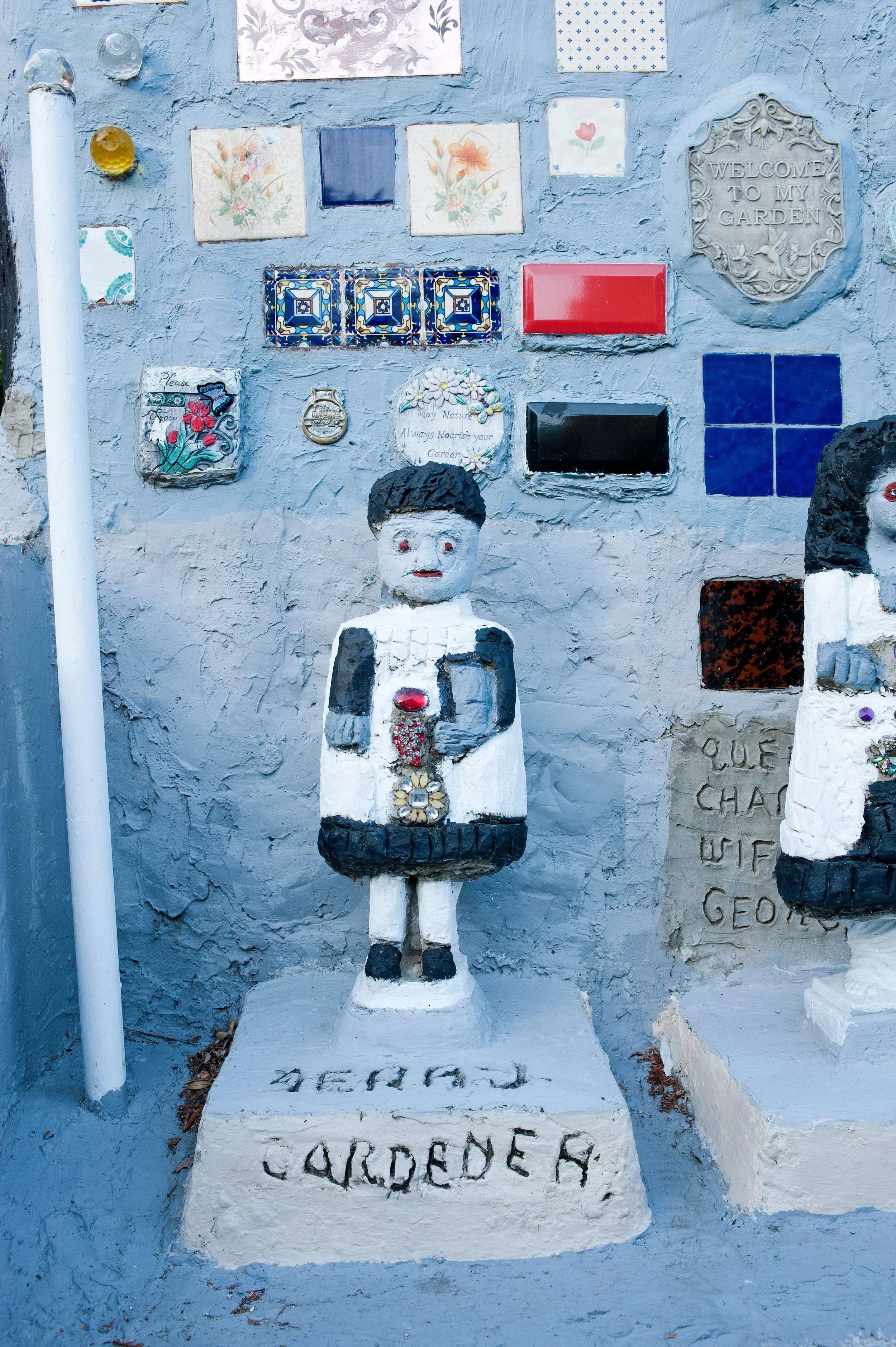
Gerry’s Pompeii sculpture on the Grand Union Towpath
Wright’s quote is a powerful encapsulation of ‘outsider art’, but Galitzine notes that the term is a contested category. In the past, it has occasionally been associated with pejorative connotations about their creators’ mental health: ‘aren’t all artists outsiders?’, she asks. For Galitzine, visionary artists are also defined by their disinterest in external appreciation: rather than creating for posterity, commercial success, or even to show others, their work is its own reward.
‘Aren’t all artists outsiders?’
One might argue that categorising Wright (who created something he wanted others to see) in the same breath as Dalton, who expected his work to be unearthed rather than exhibited, isn’t a fair comparison. Perhaps Gerry’s Pompeii comes closer in intention to creations like Watts Towers, seventeen intricately decorated towers built in Los Angeles by an immigrant construction worker.
Ambitious and dazzling, it echoes the individual spirit that makes Gerry’s Pompeii so intoxicating. This kind of debate and splitting of hairs can make ‘outsider art’ tricky to define.
Nonetheless, for those who are usually classified as outsider artists, the house and garden seem to be their natural canvas, a space they can exercise their imagination at scale. Without access to grand studios or gallery walls, they unleash their creativity on their living space, with almost no consideration for conventional good taste or functionality.
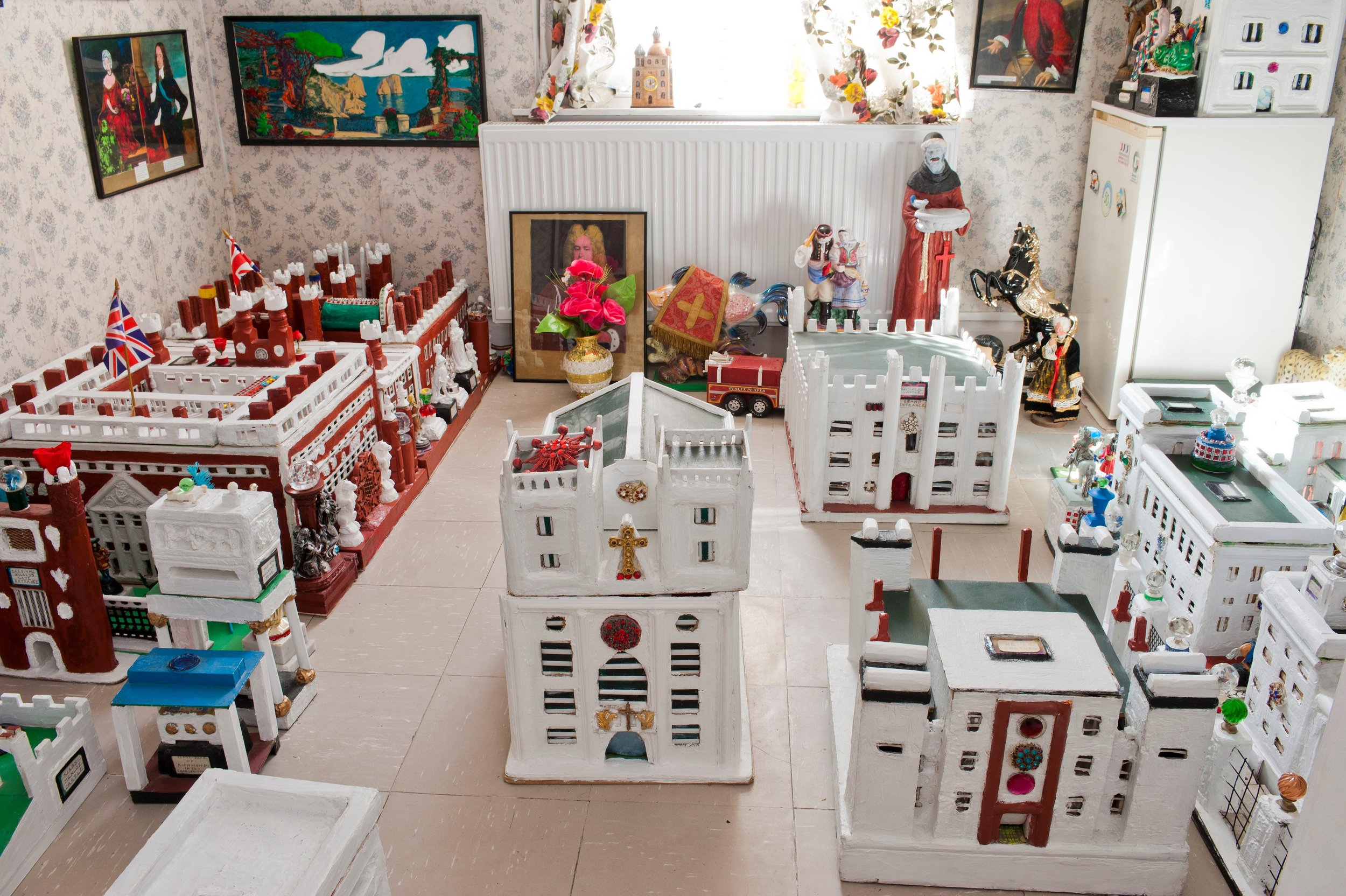
More of Dalton’s artworks, created inside his home (now unavailable to view)
These homes are an extremely personal vision of what is beautiful
The physical home becomes an extension of their thoughts, a literal chamber of jumbled colour and shape we can peer into and that follows its own unknowable logic. Often cobbled together using cheap odds and ends, reclaimed rubbish or broken objects, these homes are an extremely personal vision of what is beautiful.
The great emotional intimacy of such spaces stokes a protective feeling in audiences. ‘This probably wouldn’t still be here if it wasn’t for all the people I’ve met,’ says Galitzine of Gerry’s Pompeii. She notes the neighbourhood’s coordinated efforts to preserve Gerry’s legacy, and the community work undertaken by volunteers to help raise funds. Perhaps we’re also drawn to the courage of the person willing to throw the rulebook out the window and just do what feels ‘right’.
May we all reach more boldly for the next knickknack that catches our eye and allow our intuition to guide the creative spark in us that Gerry undoubtedly answered to. Who knows, maybe we’ll also end up leaving what Galitzine calls ‘a different kind of heritage.’
Photos courtesy of Jill Mead