
Celebrating the Dark Side of the Festive Season
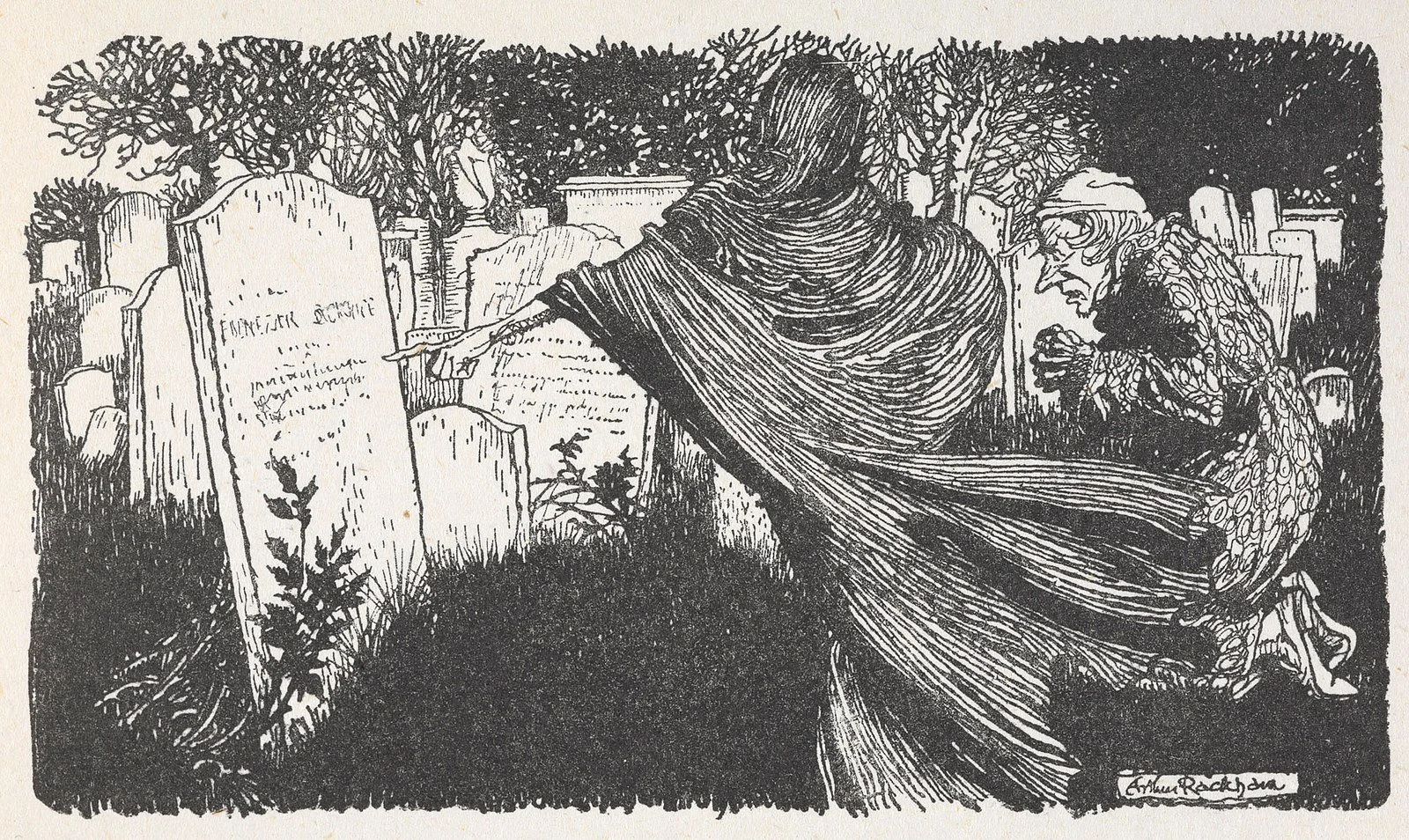
Arthur Rackham’s illustration for A Christmas Carol: Ghost of Christmas Yet To Come reveals Scrooge’s fate
Despite American crooner Andy Williams’ proclamation that Christmas is the ‘most wonderful time of the year’, it’s not a coincidence that some of our most loved tales, songs and visual art focuses on a darker side of the festive season.
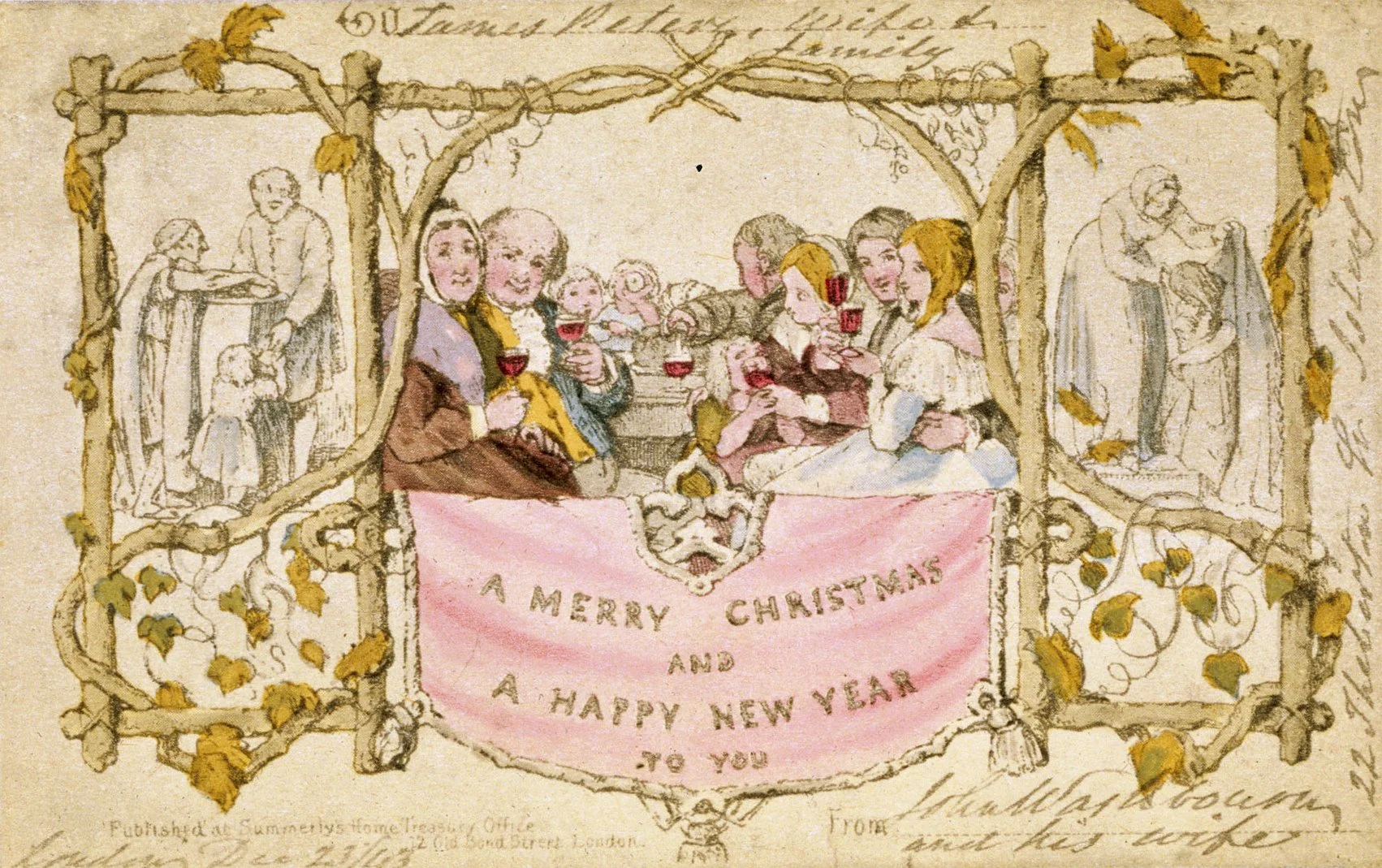
Henry Cole’s first commercially produced Christmas card
Christmas, as we know it, is largely the result of the Victorian era’s fanatical PR effort – you know, the same people who were taking family photos post-mortem and weaving their dead children’s hair into lockets? Given their obsession with death, it should come as no surprise that underpinning the jollity of the season is a distinct air of the gothic; whether it’s Marley’s ghost promising Scrooge eternal punishment or Bavarian monsters carrying misbehaving tots away in their sack. For the truth is, Christmas has always brought a sombre note along with the snow.
It was the Victorians who insisted on the now-traditional Christmas card. Commissioned by Henry Cole in 1843, the very first festive greeting card depicted acts of charity and revelry alike. Flanking a domestic scene (in which a nurse gladly pours wine down her charge’s neck) are tableaux of ghostly figures, feeding the poor and clothing the naked.
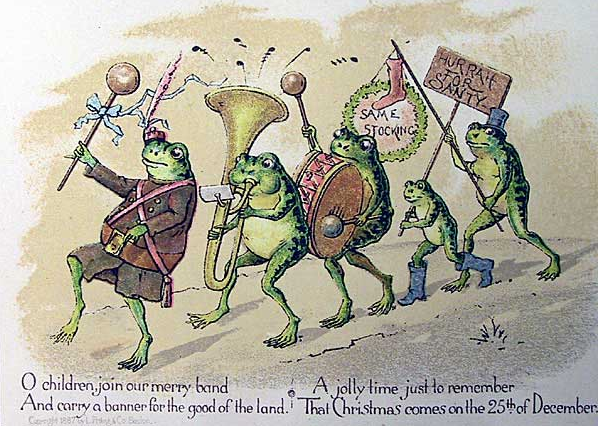
Louis Prang’s frog-themed Christmas card
Christmas has always brought a sombre note along with the snow.
From this early incarnation, there was a morbidity to Victorian Christmas celebrations that manifested as a range of downright strange greeting cards, from dead birds to boiling children. Charles Dickens’ A Christmas Carol capitalises on this nineteenth-century appetite for grisliness with Scrooge and his cornucopia of visiting ghosts. He fleshes out his story with lost love, starving children, and the promise of a widely celebrated death.
Christina Rossetti’s In the Bleak Midwinter, originally also titled A Christmas Carol, captures a similar fought-for optimism that reveals itself in ‘the bleak winter’. Instead of riches, flocks of sheep or heralding angels, her protagonist settles on the touchingly humble gift of their heart – all that they have to offer in the cold of winter. Just as Dickens’ classic is adapted time and time again (with muppets and without), Rossetti’s poem has been performed by university choirs, Bert Jansch and Wolf Alice alike – all seemingly drawn to this particular brand of Christmas melancholy.
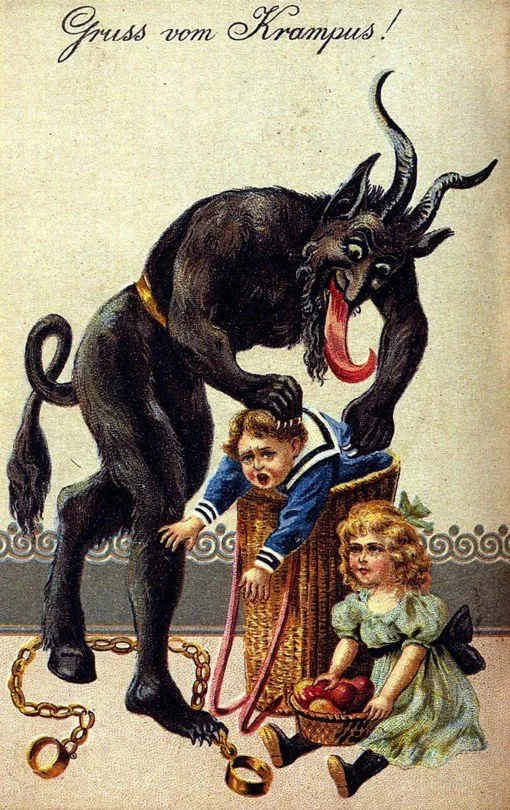
‘Greetings from Krampus!’
These Victorian traditions are rooted in Christianity, but if you look at folk traditions, even darker themes appear around solstice celebrations. A quick journey over the English Channel and you’ll find the monstrous Krampus knocking at your door. Originating in German-speaking areas of Europe, this demonic foil to St Nicholas comes to collect naughty children who are whipped, thrown into a sack and carried away on Krampusnacht. The fanged goat-like figure is said to be the son of Hel, befitting nature’s death that comes with the passing of autumn.
If you look at folk traditions, even darker themes appear around solstice celebrations.
While threatening our children with a stocking of coal might seem like small beer measured against Krampus’ fondness for a whip, nonetheless, such hostile urges surface and place our morality under scrutiny. Perhaps it’s the harshness of the weather. Or perhaps it’s the niggling ghosts, whispering our failings from the year past as we try and drown them out with festive drinking.
Even as the turn of the century brought more modern concerns, Christmas continued as a beacon of hope, tied to Dickensian themes of pestilence, war and poverty. Charity fundraising efforts have concentrated around this time period, such as the Red Cross’ festive appeal to beat TB. Songs such as Jona Lewie’s ‘Stop the Cavalry’ or Band Aid’s ‘Do They Know It’s Christmas?’ also underscore those who have not during a time of apparent plenty.

Red Cross campaign advertising Christmas seals, labels similar to stamps sold to raise funds for anti-tuberculosis programmes
These ghosts – very literally represented in the Red Cross’ campaign – might not be the obvious demons and ghouls of the previous century, but they’ve continued to haunt the visuals of Christmas into our own time. From Sainsbury’s adverts to Salvation Army appeals, festive joy comes tempered with everyday troubles brought to the fore. Perhaps December will always have to balance dreams of transformation against harsh reality.
There’s just as much festive feeling in visiting old family graves to honour the past.
But all this is to say: the Christmas season doesn’t have to come wrapped in perfect smiles and cornea-burning LEDs. We’re naturally drawn to tradition – and I’ve found there’s just as much festive feeling in visiting old family graves to honour the past as there is settling on the sofa with a box of Quality Street.
So, this Christmas, when you’re walking through the hell of Oxford Street, your local supermarket or – God forbid – a multilevel shopping centre, embrace the true spirit of the season: survival, judgement, and a touch of melancholy. It might look bleaker, but I promise it feels just as warm in its own way – no batteries required.
All images are public domain via Wikimedia Commons