
Experimenting With Empire: Donald Locke At Camden Art Centre
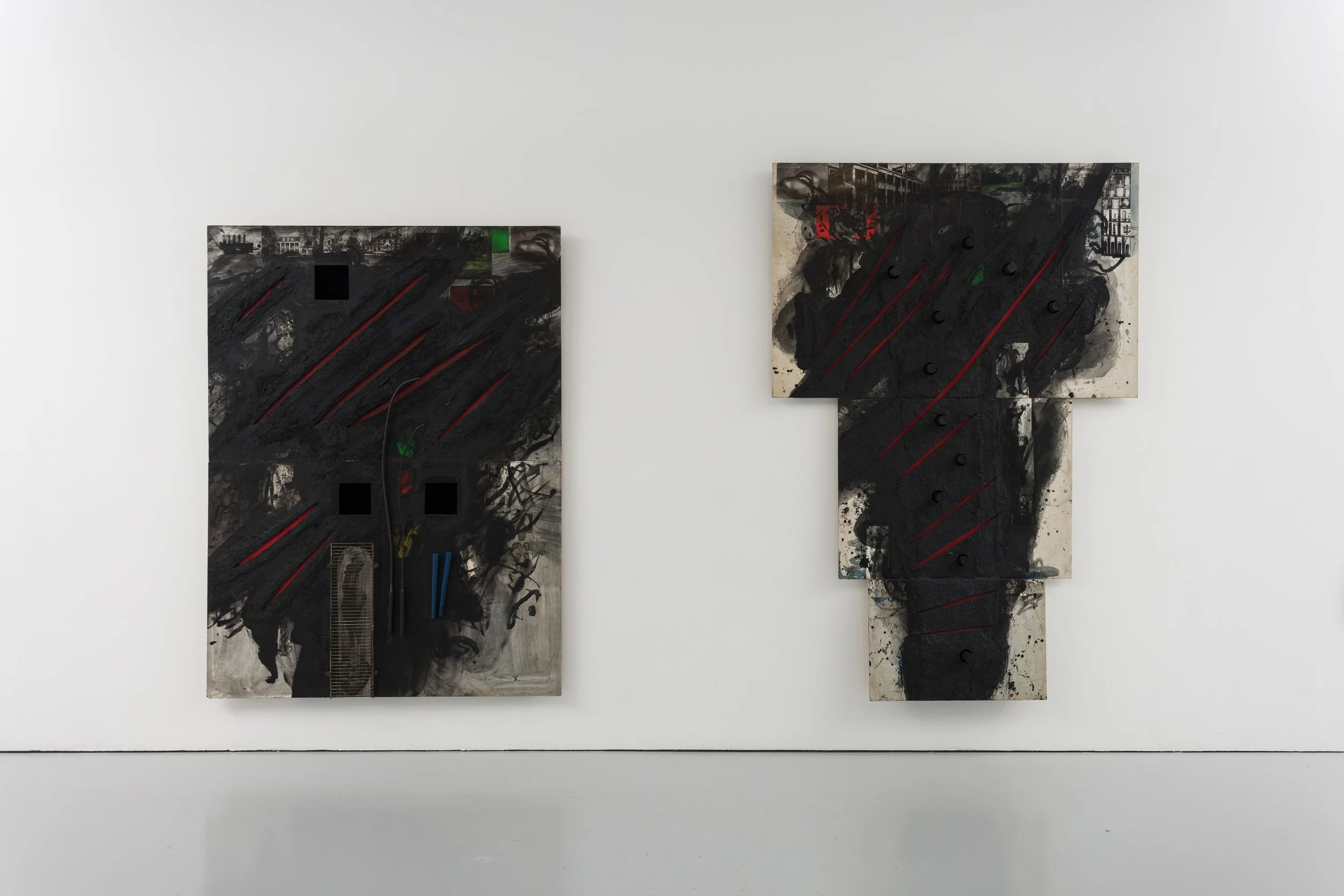
Donald Locke: ‘Resistant Forms’ (2025). Installation view at Spike Island. Image courtesy the artist. Photography by Rob Harris.
It’s coming home—no, not the football, but the under-recognised work of Guyanese artist Donald Locke. Donald Locke: Resistant Forms, a long-overdue survey of his work, has toured Bristol and Birmingham, and come full circle to Camden Art Centre, where Locke’s work appeared in two group exhibitions in the 1970s.

Twin Form (black interior), 1978. Courtesy Estate of Donald Locke and Alison Jacques © Estate of Donald Locke; Photo: Michael Brzezinski.
Locke’s career is remarkable for its hybridity and interdisciplinary depth
Born in Guyana, in his twenties Locke received scholarships from the British Council and Guyanese government that allowed him to study art in the UK. He lived in the UK, Guyana and the US, eventually settling in Atlanta, where he made some of his most experimental works.
Locke’s career is remarkable for its hybridity and interdisciplinary depth, and this show offers insights into his use of mediums like ceramics, videos, installations, and mixed-media paintings. It starts with his early ceramics, smooth vessels that evoke organic forms both human and botanical—lungs, muscles, seed pods. Rejecting the conventions of mid-century British studio pottery, they hint at the subversion and experimentation that would define Locke’s output.
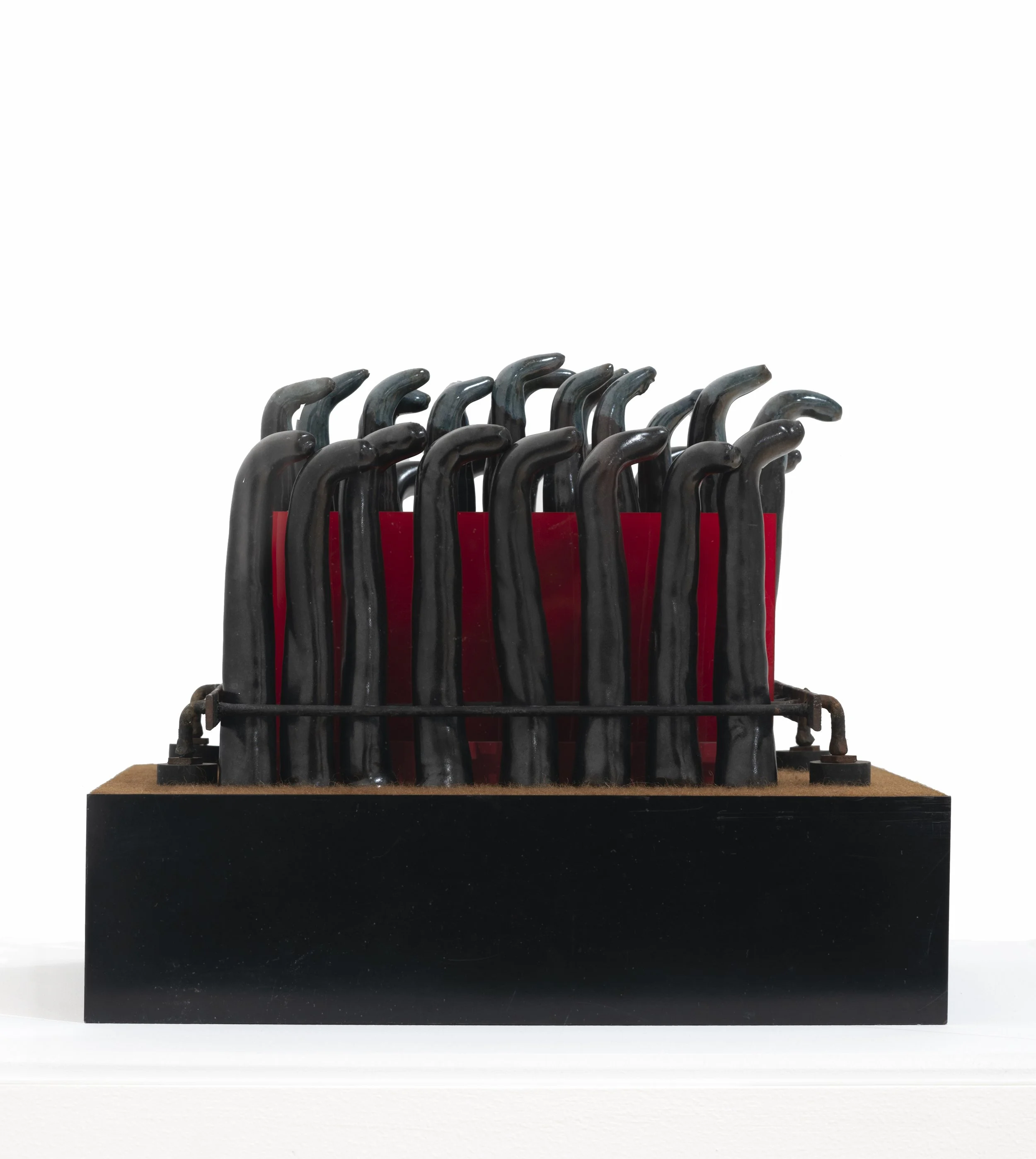
Plantation K-140, 1974. Tate: Purchased with funds provided by The Joe and Marie Donnelly Acquisition Fund 2021.
Representing the subjugation and exploitation of slave plantations, it’s a striking use of formal abstraction
Take the paintings and sculptures of his Plantation series (c.1972-6). Here, black monochromatic grids are disrupted by unnerving assemblages of leather, metal and fur. Representing the subjugation and exploitation of slave plantations, it’s a striking use of formal abstraction—unexpectedly mixed with such tactile, charged materials—to represent landscapes still scarred by violent histories.
A standout work is Trophies of Empire (1972-4), a large cabinet full of dark cylindrical forms, ominous in their ambiguity and uniformity, which are mounted onto objects Locke sourced from London markets and second-hand shops. The artist maintained that these cold, menacing forms were bullets, but the phallic overtones are hard to ignore. Like so much of the work on display here, it’s rich with ambiguity but communicates a daunting sense of violence and domination, defining elements of the colonial enterprise.

Enigma Variations, 1993. Courtesy Estate of Donald Locke and Alison Jacques © Estate of Donald Locke. Photo: Michael Brzezinski.
Their visceral nature speaks to the liberation the artist felt in leaving the UK for the US
The largest room in the show is dedicated to the imposing mixed-media paintings that Locke produced in the 1990s. A charred black palette still dominates, punctured with bleeding blues and ghostly found images: of Queen Victoria, Locke’s own sculptures, Confederate flags and antebellum plantation houses. Their visceral nature speaks to the liberation the artist felt in leaving the UK for the US, escaping ‘the weight of tradition’ he experienced in Europe.
VISITING INFO:
GALLERY NAME: Camden Art Centre
ADDRESS: Arkwright Rd, NW3 6DG
DATES: 10 Apr - 30 Aug 2026