
An Angel Walks Into a Pub… and Falls: Sculptor Rufus Martin on Humanity
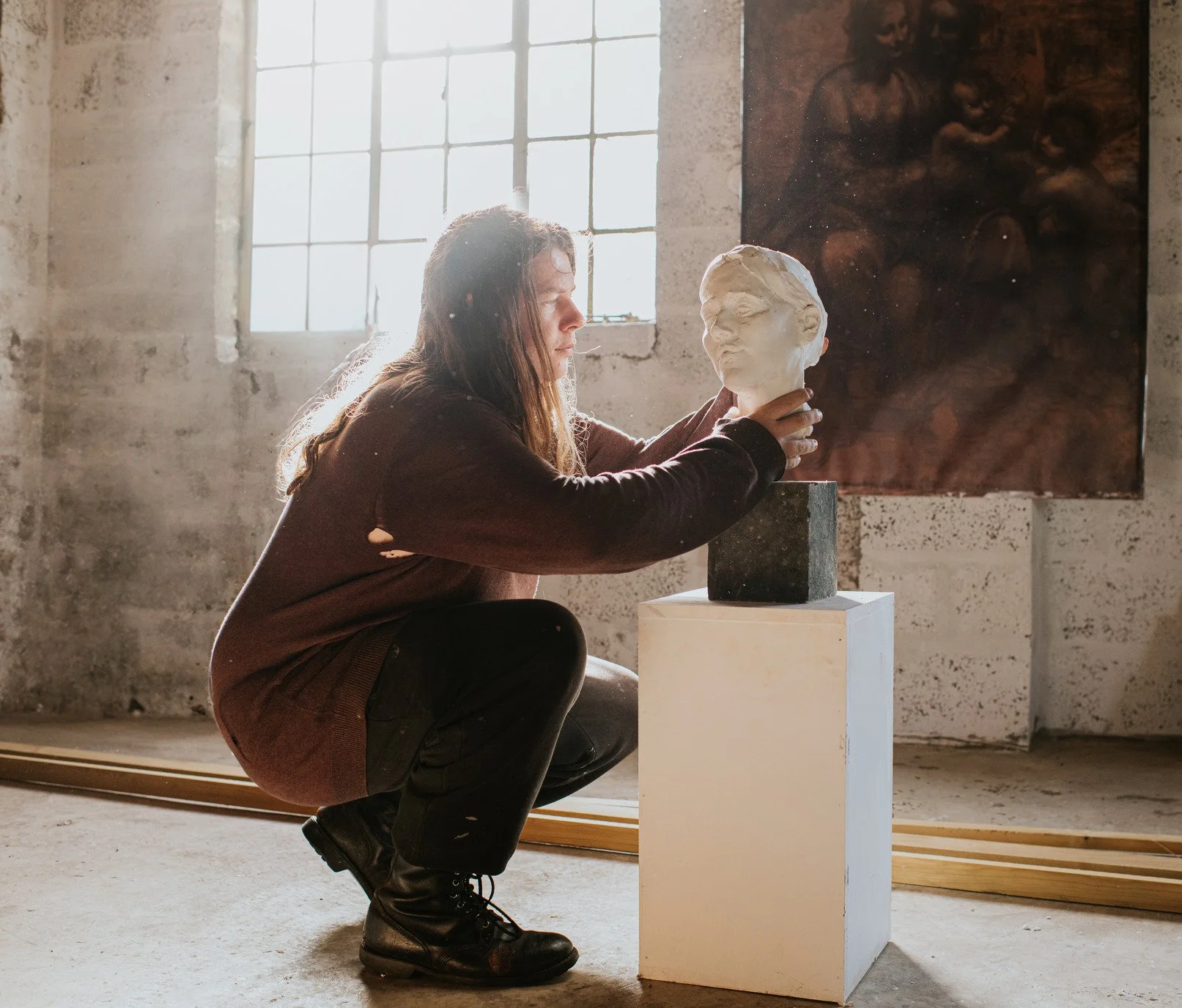
Rufus Martin in his studio (image credit: Catherine Falls)
In a village library in Dorset, time is measured carefully between opening hours, and dated by the books on the shelves; some by Jilly Cooper, a few by Roald Dahl. But in the small flat above the library, time fractures for those who enter. Italian Baroque furniture gathers around an empty fireplace, and paintings from three centuries scatter the walls. Everything is dredged from the past and given a new life.
This is the home which sculptor Rufus Martin shares with his wife and it reflects his interest in past times and time now passing. In his portrait sculptures, he attempts to capture the inner lives and fleeting expressions of some of Dorset’s residents. While people can’t stop time, sculptors have the rare gift of capturing a moment – something which Martin is both joyfully, and painfully, aware of.
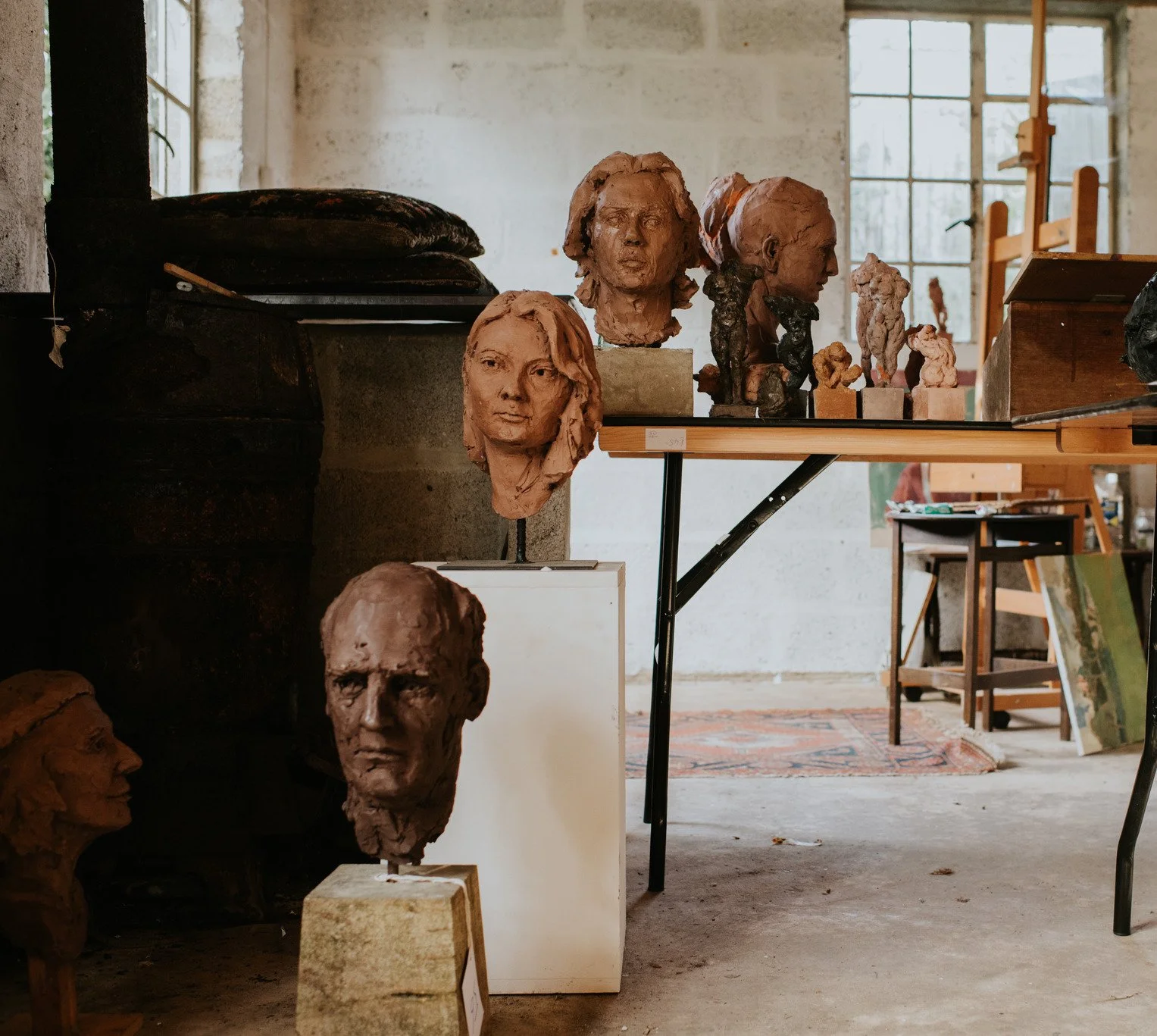
Martin’s studio (image credit: Catherine Falls)
Martin knows sculpture can capture a likeness, and sometimes a memory, due to his own experience. From the ages of 17 to 22, he was mentored by set designer Michael Howells, who died abruptly. ‘That was very shocking, losing someone who had such a strong effect on me. Anyone who knew Michael understood the power of this person.’ To process this, a week after Michael’s death and while still close enough to his memories, Martin sculpted a bust of him. ‘I just used my fingers, no tools.’
‘‘Even if it’s just the barest echo of a likeness, the smallest sliver of something, I think that’s worth trying to do.’
Since then – now using tools, clay, bronze and occasionally marble – Martin has sculpted over fifty people, the heads of whom crowd his studio. Some have since passed or were commissioned posthumously, and he has endeavoured to capture them. ‘Even if it’s just the barest echo of a likeness, the smallest sliver of something, I think that’s worth trying to do.’ Almost a decade after he made this first bust, his sculptures inspired by John Milton’s Paradise Lost sit in London’s prestigious Bowman Gallery.
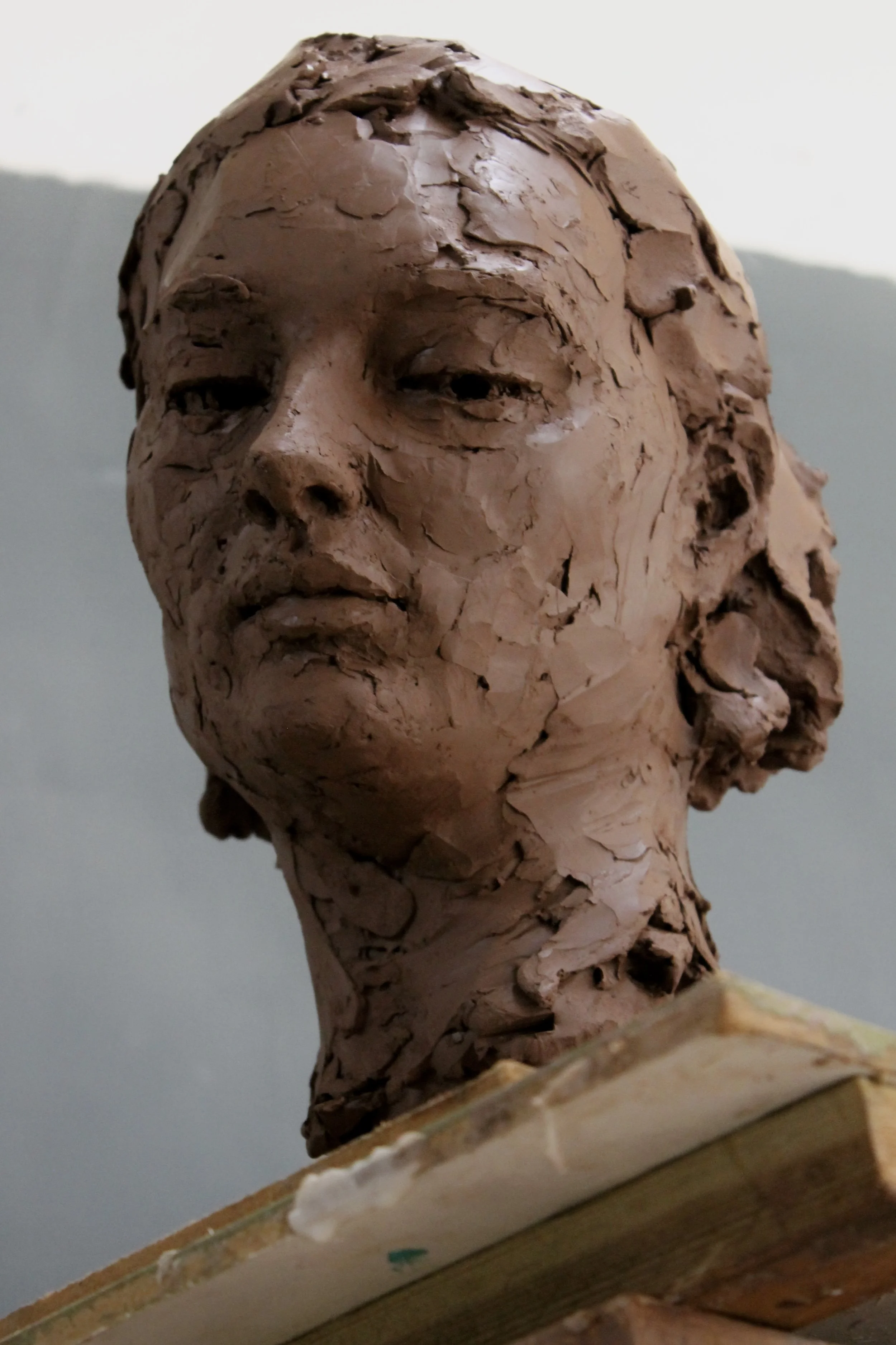
The article’s author, Alex Howlett, as captured by Rufus Martin
Martin sculpts from the world around him because he considers this to be sufficiently fascinating and complex. ‘I don’t drink. I don’t do many things that take me out of reality. I like to do things that help me walk towards the things that are difficult.’
From the village where he lives, there is a lane leading to a working farm. Away from the main farmhouse an old outbuilding has been converted into his studio. Cold rises off the cement floor, which is covered by an old rug and scattered playing cards he uses for moulds. This is where he will spend a weekend sculpting someone, submitting to what Martin describes as ‘eight hours of constant conversation and understanding’.
‘I like to do things that help me walk towards the things that are difficult.’
The sitter’s comfort is Martin’s priority, and he works to make them feel at ease, providing a hot water bottle in winter and countless cups of tea. Those who smoke do so, dropping ash while Martin marches forward and back, apparently measuring the proportions of their face with callipers, but also quietly searching for something more as they speak. He understands that conversation can make people feel vulnerable, explaining that the process is ‘loving, but you can be sculpting someone whose own partner has never looked at them this closely.’
Conversation is only one way he captures a personality. He is fixated on the ‘marks and scrapes, cuts and scratches’ that can litter his sculptures and, he believes, bely something of that person’s emotional state. The clay which Martin uses allows him to make mistakes and build a person’s likeness using broad strokes. He works with large clumps that can quickly change an expression or widen an eye.
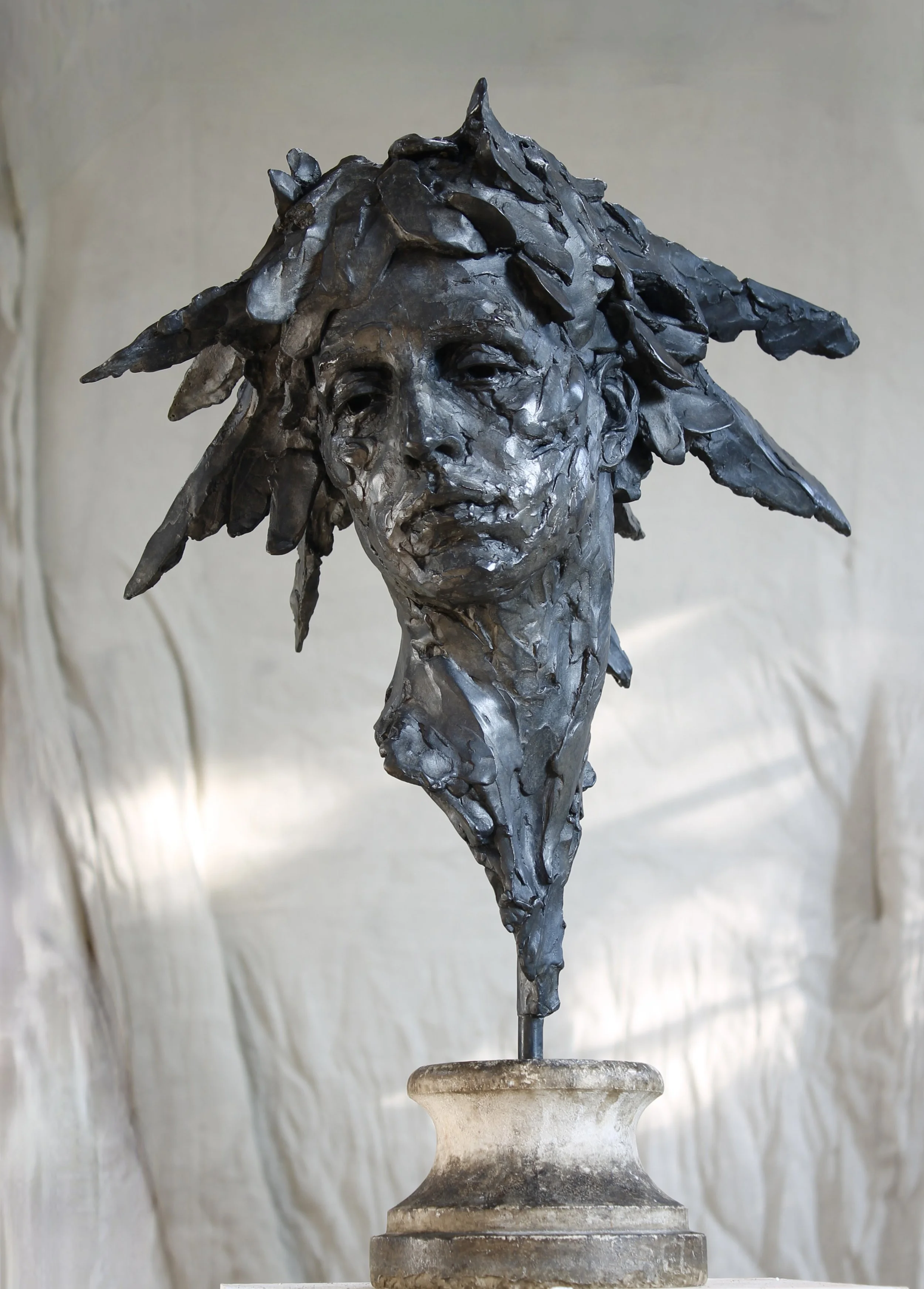
‘Sin’ by Rufus Martin
His relentless fascination with other people is central to Martin’s work; he believes there is no such thing as an ordinary person. ‘People walking down the street or chatting. It’s a miracle,’ he shares. Although he has realised he can’t ‘sculpt everyone’, he can attempt to capture the universal highs and lows of life. This is how he came to John Milton’s Paradise Lost, and this verse:
Abashed the Devil stood,
And felt how awful goodness is, and saw
Virtue in her shape how lovely—saw, and pined
His loss…
By 2023, Martin had spent years sculpting people and carrying their secrets. While working on these portraits, he had been quietly running through those lines in Paradise Lost, reflecting on the thread connecting his sitters and the archetypal characters of Milton’s work. In these words, he felt ‘a huge echo of a life lived, humanity’s life,’ and specifically saw Lucifer as an empathetic, even heroic, figure. As Philip Pullman, author of His Dark Materials, put it in an essay, ‘Suppose the Fall should be celebrated and not deplored?’
He believes there is no such thing as an ordinary person.
In the same vein, Martin decided he wanted to set his hand to ‘celebrating’ these fallen characters. On New Years’ Eve in 2024, a stranger walked into the pub who captured his attention. The stranger was handsome, but Martin was more intrigued by the way he interacted with his friends, ‘the way he looked at people. It felt like an angel had walked into the pub, someone from another place - a world where things were not so hard.’
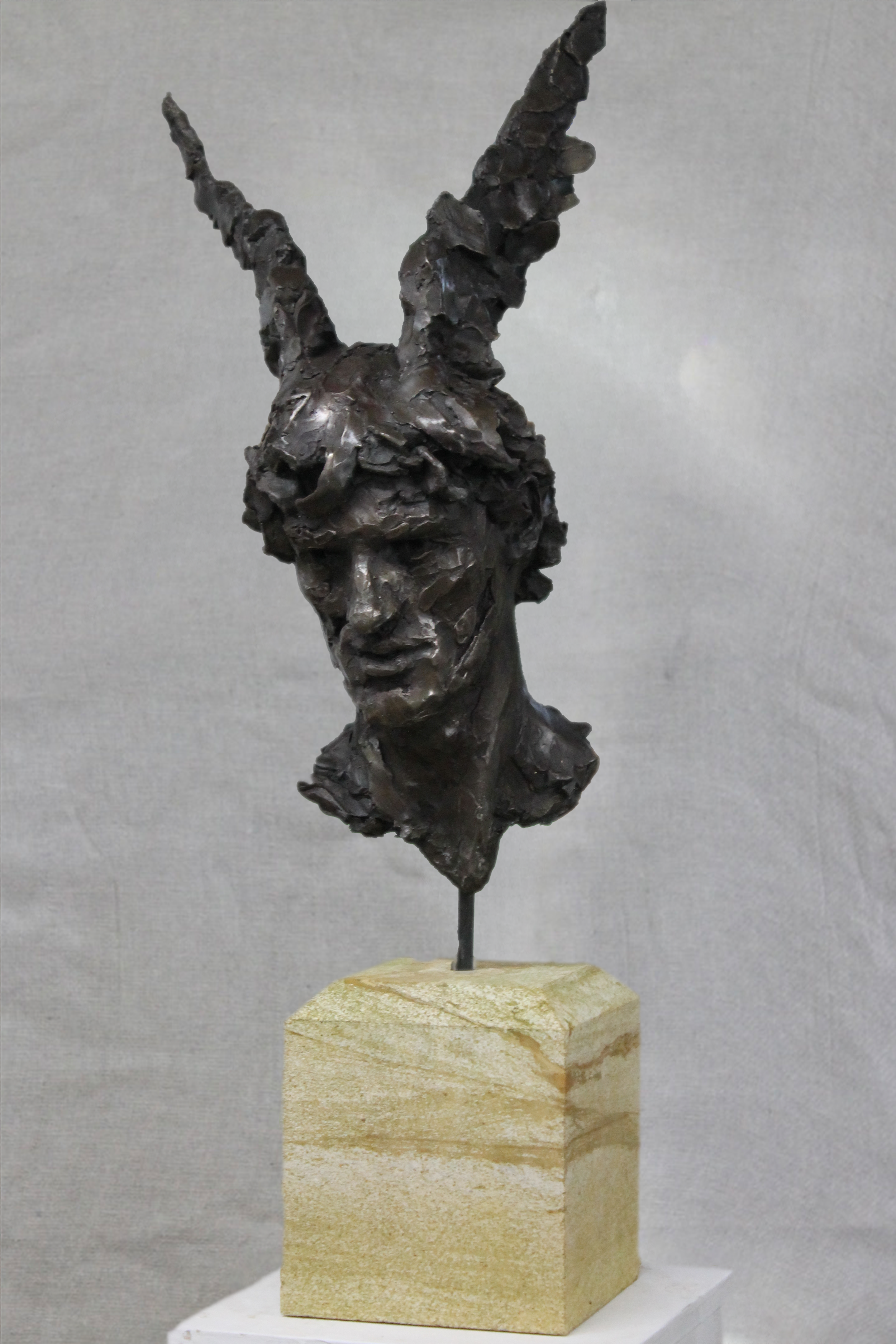
‘Lucifer’ by Rufus Martin
This man’s face became the basis for Martin’s sculpture of Lucifer, which he created some months later. Parallel to this, he’d visited Bowman gallery in London, and struck up a conversation with founder, Robert Bowman. From then on, things fell into place in an unpredictable way.
‘It felt like an angel had walked into the pub, someone from another place - a world where things were not so hard.’
Bowman Sculpture is a prestigious gallery, renown for being an authority on 19th century luminary, Auguste Rodin. Bowman has been dealing with Rodin’s works since the 1980s, hooked by his perception of beauty. When Bowman saw Martin’s output, the latter sensed an understanding of what he was trying to do. ‘We seemed to speak the same language.’ Looking at Rodin’s work – his sculptures inspired by Dante’s Inferno, his focus on hands, grasping and loose – the echoes are visible in Martin’s pieces. Mica Bowman, Robert’s daughter who runs the contemporary side, selected Martin as an ‘emerging artist’ in 2024. This feels like a natural consequence of overlapping interests.
Martin’s sculptures Lucifer and Sin are currently exhibited at Bowman as part of their current show, Frozen Forms: Contemporary Sculpture, where that same mythology is visible across the featured works. Back in Dorset, Martin is continuing his lifelong challenge to craft Milton’s characters in clay, with Adam, Eve and Death already waiting to be displayed.
As he works across these archetypal characters, however, he keeps coming back to the moment Lucifer perceives Eve and ‘pines his loss’ of innocence. As Martin sculpts more friends and strangers, shouldering their secrets as he goes, those lines by Milton will return time and again as he finds tender new ways to portray humanity’s supposed Fall.
Frozen Forms: Contemporary Sculpture can be seen at Bowman Gallery until December 19th